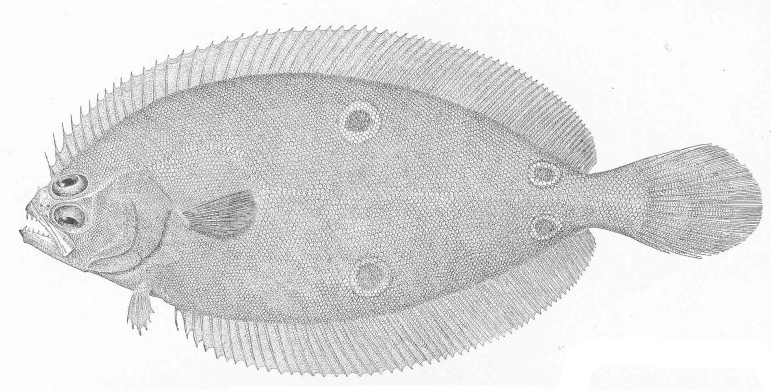
Information and species illustrations courtesy of the Food and Agriculture Organization of the United Nations (FAO).
Species Information
Size
Maximum size 41 cm total length.
Diagnostic characters
Eyes on left side of head. No spines present in fins. Mouth protractile, asymmetrical, lower jaw moderately prominent; teeth in jaws sometimes canine-like; no teeth on vomer. Preopercle exposed, its posterior margin free and visible, not hidden by skin or scales. Urinary papilla on ocular side not attached to first anal-fin ray. Dorsal fin long, originating anterior to upper eye. Dorsal and anal fins not attached to caudal fin. Both pectoral fins present. Both pelvic fins present, with 5 or 6 rays; pelvic fins symmetrically or nearly symmetrically placed on either side of midventral line (base of neither pelvic fin on midventral line). Caudal fin with 17 or 18 rays, 13 rays branched. Lateral line present and obvious on both sides of body; lateral line with high arch over pectoral fin; lateral line present below lower eye. Eyes relatively large and close set, nearly meeting, separated only by a narrow ridge; lower-limb gill rakers 7 to 11; lateral-line scales 63 to 95; 4 large dark ocelli on ocular side of body, arranged in a trapezoid with 2 in midbody (one above the other on opposite sides of the lateral line) and 2 on the body (one above the other on opposite sides of the lateral line) at a point slightly anterior to caudal peduncle; dorsal-fin rays 71 to 86; anal-fin rays 58 to 72. Colour: ocular side uniformly brownish or greyish, often with spots, blotches, or ocelli; blind side usually pale; although ambicoloration (eyed-side coloration replicated on blind side) may occasionally occur. Prominent ocelli on ocular side.
Habitat, biology, and fisheries
Inhabits bays and sounds in the northern part of the range; in progressively deeper water to 275 m or more, off Florida. Occurs in waters 8.9 to 13.9 degrees C. Spawns from May through October; peak spawning in July. Spawning begins in the southern portions of the range and progresses northward in response to increasing water temperatures. Eggs are buoyant, 0.9 to 1.12 mm in diameter with a single oil globule of 0.16 to 0.19 mm. No information on age at maturity or fecundity, but gravid females in the New York Bight ranged in size from 15 to 42 cm total length. Active during daylight hours; feeds during the day. Feeds on amphipods, mysids, and shrimps; older fishes (greater than 20 cm total length) include crabs, squids, and small fishes in the diet. No directed commercial or recreational fishery; often combined with other landings of miscellaneous flatfishes.