

Florida pompano
Trachinotus carolinus
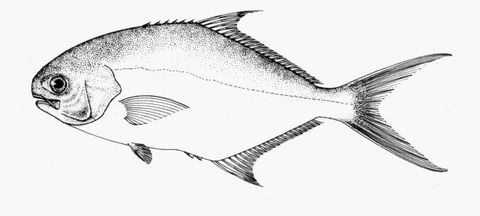
Information and species illustrations courtesy of the Food and Agriculture Organization of the United Nations (FAO).
SizeMaximum uncertain due to past confusion with the larger T. falcatus; unconfirmed report of 5.02 kg; 2.9 kg probable; common to 35 cm fork length at 1.1 kg. All-tackle IGFA world angling record 3.67 kg. |
Diagnostic charactersBody short, deep, and compressed, with upper and lower profiles similar and head profile sloping to a blunt snout. Eye small (diameter contained 3.2 to 5.1 times in head length). Upper jaw very narrow at end and extending to below mideye; lower jaw included. Teeth in jaws small, conical, and recurved, disappearing completely by about 20 cm fork length; no teeth on tongue. Gill rakers 5 to 7 upper, 8 to 14 lower. |
Habitat, biology, and fisheriesFound in small to large schools along sandy beaches, in inlets, and brackish bays. Probably spawns in oceanic waters; juveniles form immense schools along the beaches of eastern Florida from April to July. Feeds on molluscs, crustaceans, and small fish. Caught commercially with trammel nets and gill nets; also with haul seines and shrimp trawls; caught with light tackle in the surf and on shallow flats. Mostly sold fresh, some frozen; flavour rated as excellent |
DistributionFrom Massachusetts to Brazil; irregularly occurring in the West Indies (Jamaica, Puerto Rico, Tobago, Trinidad); erroneously reported from Bermuda. A geminate species, Trachinotus paitensis (Cuvier), occurs in the eastern Pacific. |
CitationsCarpenter, K.E. (ed) Carpenter, K.E. (ed) Carpenter, K.E. (ed) |