

Butterfish
Peprilus triacanthus
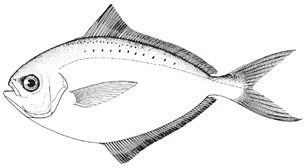
Information and species illustrations courtesy of the Food and Agriculture Organization of the United Nations (FAO).
SizeMaximum to 30 cm, commonly to 20 cm. |
Diagnostic charactersBody oval to somewhat elongate, moderately deep (its depth 2.7 to 3 times in total length) and strongly compressed. Eye medium-sized (its diameter 3.4 to 3.7 times in head length), surrounded by a small area of adipose tissue. Snout short and blunt, lower jaw projecting somewhat beyond upper.Mouth small, tip of maxillary not reaching to anterior eye margin; teeth in jaws very small, in a single row; those in the upper jaw flattened and with 3 tiny cusps. Dorsal and anal-fin bases very long (about equal in length), the anterior fin rays elevated, but fins not falcate; both fins preceeded by 3 short, weak, spines; caudal fin deeply forked; pectoral fins long (longer than head) and pointed; pelvic fins absent. A conspicuous series of 17 to 25 pores along anterior half of body under dorsal fin; lateral line high, following dorsal profile; scales small, present also on cheeks. Caudal vertebrae 17 to 20. Colour: pale blue above, silvery below; numerous irregular dark spots on sides in live fish (fading after death). |
Habitat, biology, and fisheriesA pelagic fish forming large loose schools across the continental shelf and into large brackish estuaries; over sand/mud bottoms and at depths generally less than 55 m, except during the winter months when it may descend to almost 200 m in deeper waters offshore; juveniles are often found under floating weeds and with jellyfish. Adults feed on jellyfish, small fish, crustaceans, and worms; the juveniles are plankton and jellyfish feeders; butterfish are themselves important forage species. Mature at 1 year and live to about 3 or more; spawning takes place a few miles offshore; different populations spawn at very different times of the year. Highly esteemed as a food fish, marketed fresh and frozen; caught mainly with otter trawls, but also with seines, pound nets, and handlines. The fishery, which dates to 1800, is concentrated north of the area in the Middle Atlantic Bight where landings in 1996 were 3 600 t. FAO statistics report landings ranging from 568 to 1889 t from 1995 to 1999. Landings totaled 0.31M t globally from 1950 to 2024. |
DistributionAtlantic coast of Florida in shallow and deep water, may stray very rarely around the coast into the Gulf of Mexico; absent from Bermuda, the Bahamas and the Caribbean. Northward the species is found along the USA Atlantic coast to the Gulf of St. Lawrence (greatest abundance is between Cape Hatteras and Maine) and there are tiny populations in southeastern Newfoundland. |
CitationsCarpenter, K.E. (ed) Carpenter, K.E. (ed) Carpenter, K.E. (ed) |