

Bullnose stingray
Myliobatis freminvillii
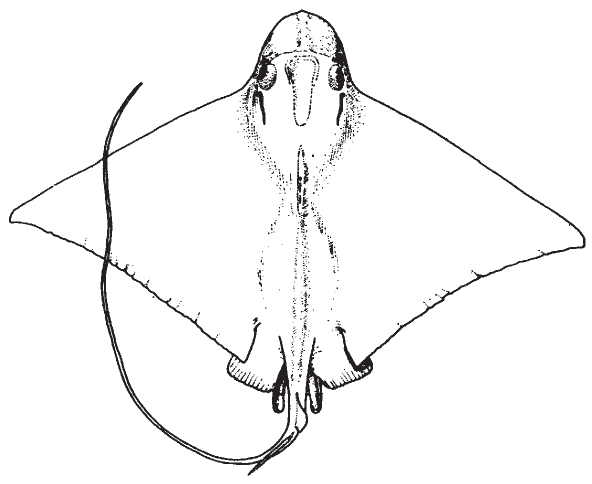
Information and species illustrations courtesy of the Food and Agriculture Organization of the United Nations (FAO).
SizeMaximum size 86 cm; common to 70 cm disc width; males mature at 60 to 70 cm disc width; neonates 25 cm at birth. |
Diagnostic charactersDisc rhombic, about 1.6 to 1.8 times as broad as long. Head distinctly elevated from disc; snout moderately short, preorbital length 7 to 10% of disc width, subrostral lobe located below anterior part of head, rounded, and continuous with remainder of pectoral fins; eyes and spiracles on sides of head; teeth flat hexagonal plates, usually in series of 7, occasionally more or fewer (but never a single series), those of the median row much larger than the others; nasal curtains fringed and not indented at symphysis of jaws; floor of mouth with 5 or 6 papillae. Distance between fifth gill openings about equal to distance between inner edges of nasal apertures. Corners of pectoral fins markedly acute-angled; small dorsal fin close behind rear tips of pelvic fins; no caudal fin. Whip-like tail distinctly marked off from body, much longer than disc and without longitudinal folds or ridges. One or 2 long, serrated tail spines close behind dorsal fin. Skin smooth on small individuals; larger individuals with low tubercles in a medial row on shoulder, and adult males additionally with a single thorn above each eye. Colour: dorsal surface greyish, reddish brown, or dark brown, with diffuse whitish spots (these usually smaller than eye diameter); ventral surface white.Dorsal fin occasionally paler; posterior part of tail dark brown or black; teeth green. |
Habitat, biology, and fisheriesFound most frequently in coastal waters, to 10 m depth, mainly in shallow estuaries. In the northern part of its range, this species migrates northward during early summer and southward during early winter. Capable of traveling long distances; occasionally leaping out of the water. Food consists of bivalves, gastropods, and crustaceans (lobsters and crabs). Caught mainly on longlines and with trammel nets. Marketed salted in limited quantities. |
DistributionOccurs from Cape Cod (rarely) to southern Brazil, Uruguay, and northern Argentina. Also present in the northern Gulf of Mexico, but absent from the Greater and Lesser Antilles and Bahamas. Presence in the Caribbean appears to be limited to northern South America. |
CitationsCarpenter, K.E. (ed) Carpenter, K.E. (ed) Carpenter, K.E. (ed) |