

Atlantic spadefish
Chaetopterus faber
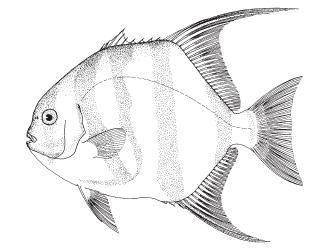
Information and species illustrations courtesy of the Food and Agriculture Organization of the United Nations (FAO).
SizeMaximum to 1 m, commonly to 50 cm. |
Diagnostic charactersBody deep, included 1.2 to 1.5 times in standard length, orbicular, strongly compressed. Mouth small, terminal, jaws provided with bands of brush-like teeth, outer row larger and slightly compressed but pointed at tip. Vomer and palatines toothless. Preopercular margin finely serrate; opercle ends in blunt point. Dorsal fin with 9 spines and 21 to 23 soft rays. Spinous portion of dorsal fin low in adults, distinct from soft-rayed portion; anterior portion of soft dorsal and anal fins prolonged. Juveniles with third dorsal fin spine prolonged, becoming proportionately smaller with age. Anal fin with 3 spines and 18 or 19 rays. Pectoral fins short, about 1.6 in head, with 17 or 18 soft rays. Caudal fin emarginate. Pelvic fins long, extending to origin of anal fin in adults, beyond that in young. Lateral-line scales 45 to 50. Head and fins scaled. Colour: silvery grey with blackish bars (bars may fade in large individuals) as follows: Eye bar extends from nape through eye to chest; first body bar starts at predorsal area, crosses body behind pectoral fin insertion, and ends on abdomen; second body bar incomplete, extending from anterior dorsal-fin spines vertically toward abdomen but ending just below level of pectoral-fin base; third body bar extends from anterior rays of dorsal fin across body to anterior rays of anal fin; last body bar runs from the middle soft dorsal fin rays to middle soft anal-fin rays; last bar crosses caudal peduncle at caudal-fin base. Young entirely dark brown or blackish with white mottling; caudal fin, pectoral fins, and edges of soft dorsal and anal fins hyaline. |
Habitat, biology, and fisheriesInhabits a variety of different habitats along shallow coastal waters, including reefs, mangroves, sandy beaches, harbours, around wrecks and pilings, and under bridges. They are often seen in large schools of more than 500 adult individuals. Juveniles are apt to be encountered around mangroves in their dark coloration with white mottling. This cryptic coloration, when combined with the juveniles’ habit of floating tilted on its side, mimics the dead mangrove leaves and possibly other floating objects making the fish difficult to detect. Fish even up to a foot in length may take on the dark colour and float tilted on their sides over the light coloured sand. The barred forms are almost always vertically oriented. Feeds on a variety of invertebrates, both benthic and planktonic, as well as algae. Adult spadefish will readily take a baited hook and have a firm, well-flavoured flesh. There is no extensive fishery for them. Juveniles are occasionally caught for the live topical fish hobby market, but are not as greatly prized as many of the more colourful reef species. |
DistributionMassachusetts to southeastern Brazil, including the Gulf of Mexico. Introduced to Bermuda. |
CitationsCarpenter, K.E. (ed) Carpenter, K.E. (ed) Carpenter, K.E. (ed) |