

Atlantic moonfish
Selene setapinnis
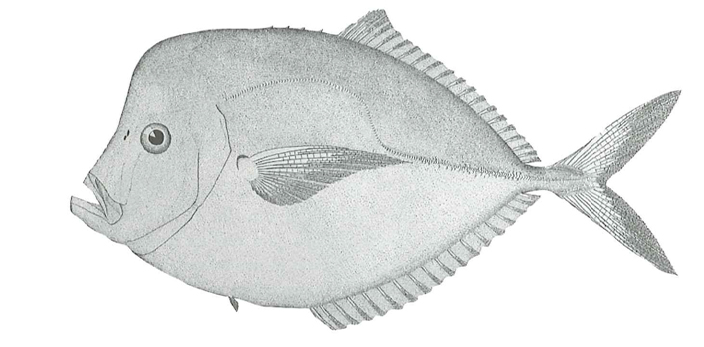
Information and species illustrations courtesy of the Food and Agriculture Organization of the United Nations (FAO).
SizeMaximum to 33 cm fork length; 39 cm total length; common to 24 cm fork length. |
Diagnostic charactersBody short, very deep (at sizes greater than 10 cm fork length, body depth 46.0 to 51.5% fork length), and extremely compressed, with ventral profile more convex than dorsal; head profile rounded at top and sharply sloping through a slight concavity in front of eye to a blunt snout with lower jaw protruding. Eye moderately small (diameter contained 3.4 to 3.7 times in head length). Upper jaw short, expanded at posterior end, and ending far below and about under anterior margin of eye. Teeth relatively small; upper jaw with a narrow irregular band; lower jaw with a narrow irregular band tapering to an irregular row posteriorly. Gill rakers 7 to 10 upper, 27 to 35 lower, and 34 to 44 total. Dorsal fin with 8 spines, followed by 1 spine and 21 to 24 soft rays; anal fin with 2 spines (resorbed into body at about 13 cm fork length) separated from rest of fin, followed by 1 spine and 16 to 19 soft rays; first 4 dorsal-fin spines elongated in fish shorter than 6 cm fork length, with the longest (second) spine about equal in length to body depth, these spines becoming very short and nearly resorbed by 30 cm fork length; second dorsal-fin lobe only slightly elongated, shorter than head, contained 7.5 to 11.4 times in fork length; pelvic fins relatively short at all sizes, becoming nearly rudimentary (contained 7.2 to 9.8 times in pectoral fin length). Scutes in straight part of |
Habitat, biology, and fisheriesA schooling species, usually near the bottom from inshore waters to at least 54 m depth. Young occur near the surface, as far as 180 km offshore. Juveniles may occur in bays and river mouths. Sexual maturity is reached by about 13 cm fork length. Feeds on small fishes and crustaceans. Caught with trawls or seines. Edibility rated poor to good. |
DistributionIn the Western Atlantic apparently restricted to continental margins from Nova Scotia to Mar del Plata, Argentina. Two closely related species occur in other areas, Selene dorsalis (Gill) in the eastern Atlantic, and Selene peruviana (Guichenot) in the eastern Pacific. |
CitationsCarpenter, K.E. (ed) Carpenter, K.E. (ed) Carpenter, K.E. (ed) |