

Shallow Water Habitats
Methods - Sampling Design
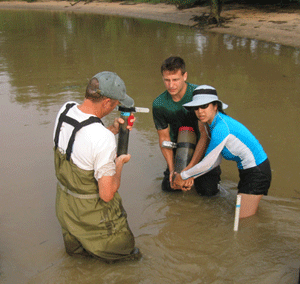 Consideration of sampling design is
critical in developing a new monitoring or hypothesis-driven sampling
program. Sampling design includes defining the questions to be
addressed by the data, defining the units that will be sampled, and
developing a sampling design that is cost-effective for answering the
defined questions. The first task is to clearly state the principal
questions that the sampling program will answer. Questions may or may
not be framed as testable hypotheses, depending on program objectives.
Consideration of sampling design is
critical in developing a new monitoring or hypothesis-driven sampling
program. Sampling design includes defining the questions to be
addressed by the data, defining the units that will be sampled, and
developing a sampling design that is cost-effective for answering the
defined questions. The first task is to clearly state the principal
questions that the sampling program will answer. Questions may or may
not be framed as testable hypotheses, depending on program objectives.
Sound statistical advice should be sought in the early stages of any sampling design development to ensure that the data collected will be sufficient to address the questions posed. For example, the degree of sample replication needed to produce statistically valid data may be determined using power analysis, which is based upon previous sampling at the site or similar sampling elsewhere. It is the responsibility of trained biologists and ecologists to understand the consequences of natural variation and to plan ahead.
Nautical and topographic charts may be used to obtain a general sense of bathymetry, bottom and shoreline types for shallow water study sites. Existing monitoring program databases may be very useful during the program design phase. Many extensive databases are available for the Chesapeake Bay region. The US EPA’s Chesapeake Bay Program and National Coastal Assessment (NCA) Program catalogue databases that can be searched for specific parameters such as water quality, sediment quality and living resources. Data are also available on the NCA site for other regions throughout the US
For additional details on sampling design considerations refer to the following:
Gibson , G.R., M. L. Bowman, J. Gerritsen and B. D. Snyder. 2000. Estuarine and Coastal Marine Waters: Bioassessment and Biocriteria Technical Guidance. EPA 822-B-00-024. U.S. Environmental Protection Agency, Office of Water, Washington, DC. (sections 5.2 and 6.8)
Underwood, A. J. and M. G. Chapman. 2005. Design and Analysis in Benthic Surveys. Chapter 1 in Eleftheriou, A. and A. McIntyre. (eds.) Methods for the Study of Marine Benthos. 3rd Edition. Blackwell Scientific, Oxford, London.