
International maritime officers connect with science at W&M's Batten School & VIMS
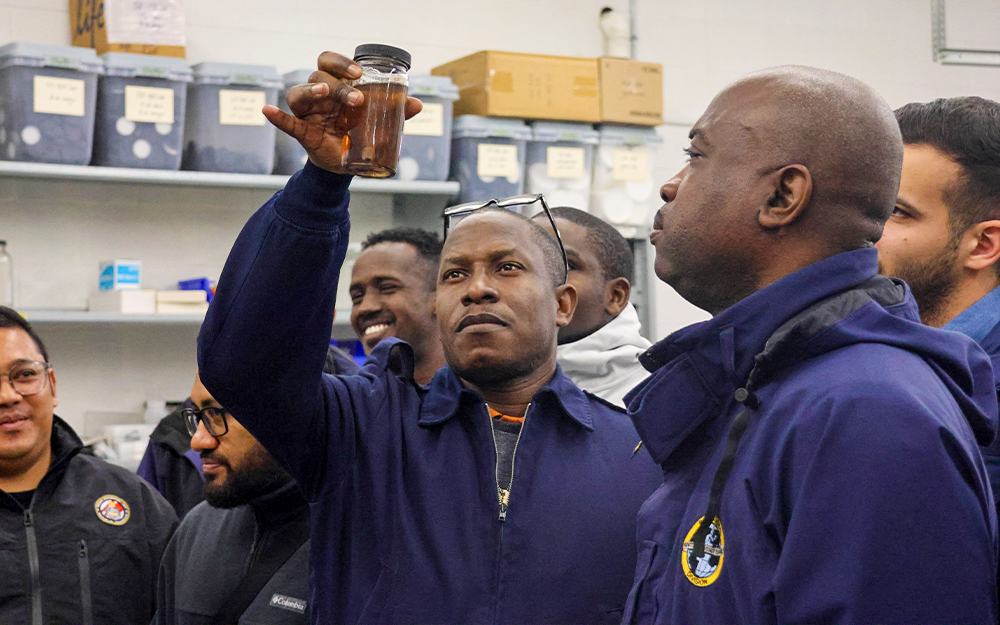 William & Mary’s Batten School & VIMS recently hosted the U.S. Coast Guard’s (USCG) International Maritime Officer’s Course (IMOC), educating global maritime leaders on how science impacts real-world decisions on issues like pollution, fisheries enforcement and coastal hazards. Hosted approximately two to three times a year by the Office of Research & Advisory Services, the training highlights how the Batten School & VIMS advisory mission reaches beyond Virginia to benefit coastal communities around the world.
“Bringing international officers here to see pollution response and prevention, and the other work you do, is something that they will take back to their countries,” said Lieutenant Christopher Xirau, who serves in the International Division at USCG Training Center Yorktown. “This program carries a lot of prestige, and many of these officers will eventually be promoted to really high levels. The hope is that when they are admirals, they will apply the lessons learned from all our different instructors, including those from VIMS.”
 Now hosting its 75th cohort, IMOC is a 12-week professional military education program designed to connect international maritime officers with U.S. Coast Guard mission planning, operations and leadership strategies. Participants, who are members of their respective nations’ coast guard, navy or maritime police, engage in a wide-ranging curriculum that spans maritime law enforcement, search and rescue, crisis management and international rule of law.
Since 2022, a daytrip to the Batten School of Coastal & Marine Sciences & VIMS has served as a key stop in the program, complementing an additional visit to W&M’s main campus. The W&M Whole of Government Center of Excellence (WGC) serves as the university contact for USCG Training Center Yorktown and coordinates both the IMOC program and another course held at W&M each year on International Maritime Domain Awareness.
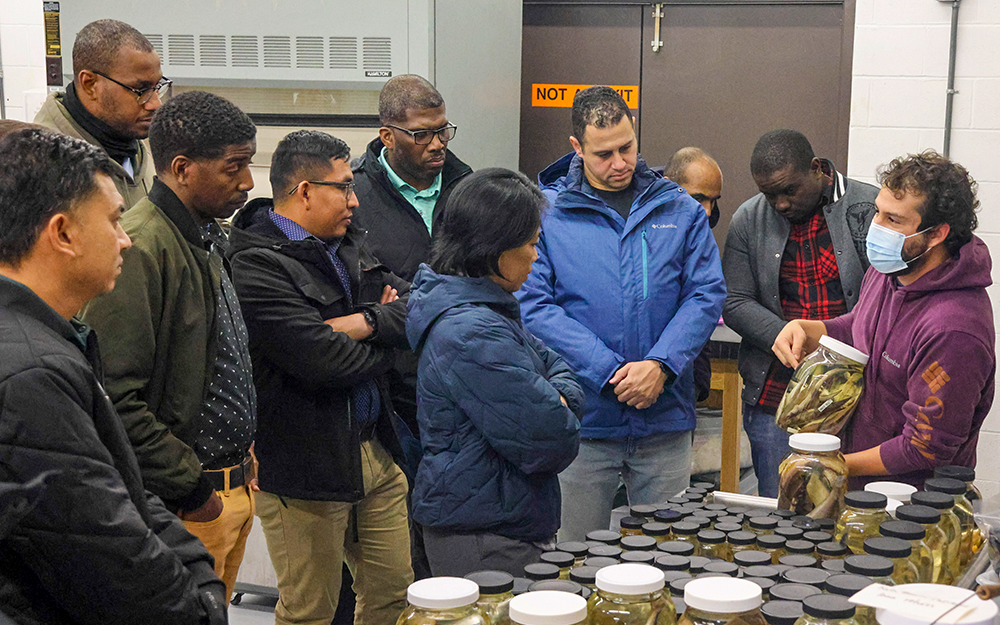
In Williamsburg, IMOC participants experience whole-of-government instruction from faculty on topics ranging from tools of national influence and entrepreneurial thinking to planning for the unknown and resource-constrained decision-making. Then, at the Batten School & VIMS’ Gloucester Point campus, officers receive an immersive look at how science informs real-world maritime operations. Presentations and tours introduce participants to topics such as spill planning and response, illegal fishing and the scientific tools that support decision-making in complex marine environments.
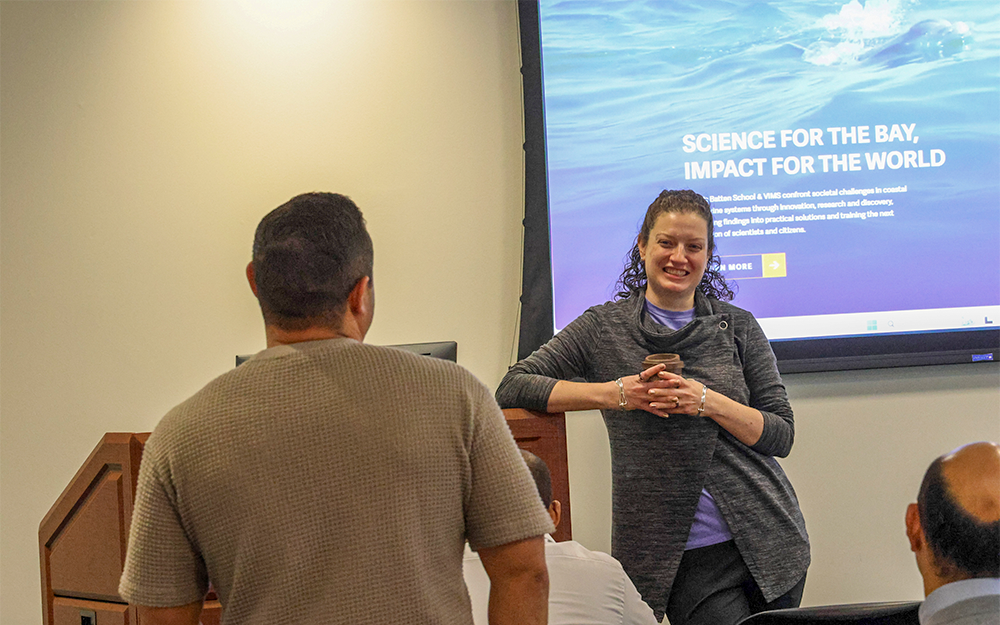 “It’s a chance to show how marine science interacts with their worlds and how it can be useful to them,” said Emily Hein, assistant director for advisory services. Hein, who works extensively with the USCG on oil and hazmat spill response planning in Virginia, says participation in IMOC demonstrates the global impact of the Batten School & VIMS. “We get the opportunity to reach all these other countries,” she said. “The goal is that when they get back home, they will center science in their actions and decision-making.”
Throughout the program, information flows both ways. “This is more of a subject matter expert exchange,” said Xirau. “We teach them how we do things in the Coast Guard, and we gather a lot of information from them as well. It’s a conversation.”
Hein agreed the IMOC participants bring insightful global perspectives to the Batten School & VIMS.
“Different countries do things differently, so it’s helpful to learn what does and does not work in various places,” she said, noting that the variety of experiences adds important nuance to the day’s discussions. “Some of them have never talked to a scientist, while others work directly with researchers. Some have never encountered these issues, while others may have seized an illegal fishing vessel just last month.”
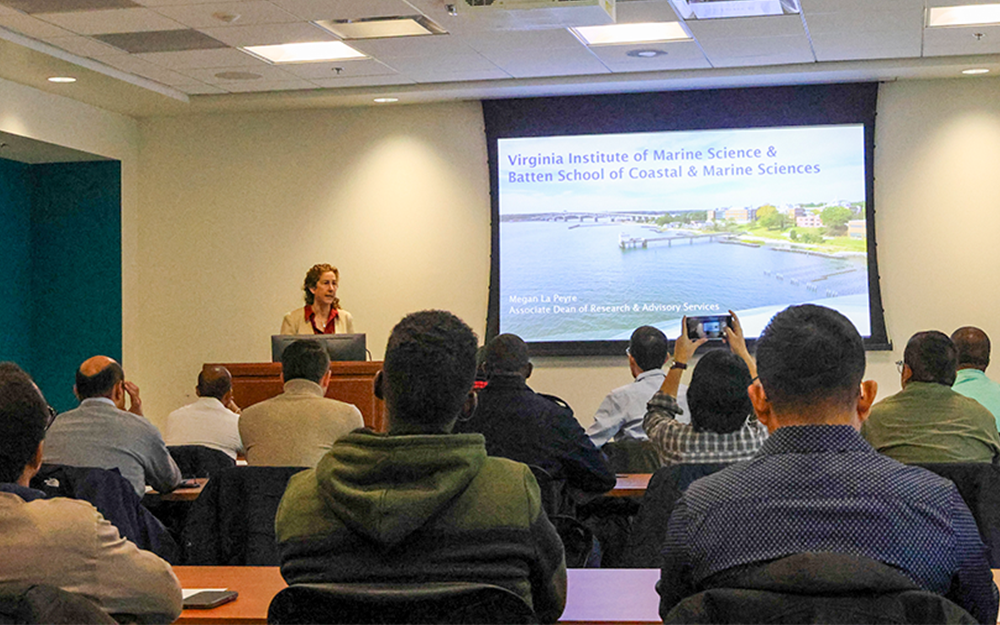 The ongoing partnership with the USCG highlights the Batten School & VIMS’ preeminent role not only in the commonwealth, but across the nation and around the world, according to Megan La Peyre, associate dean of research & advisory services. “This partnership with the USCG reflects their trust in the Batten School & VIMS as a global leader in applied marine science,” she said. “When our office connects scientists with maritime leaders, we're doing more than just sharing data; we're building shared understanding that strengthens decision-making and marine stewardship.”
Ultimately, the IMOC visit underscores a shared reality: oceans, coasts and waterways connect every nation. By bridging science and maritime operations, the collaborative partnership between the USCG, William & Mary and VIMS helps equip a global network of leaders to better understand those waters.
As Xirau put it, “Using this program to build ironclad relationships with the rest of the world is a win for the United States and for our global partners. The oceans link everyone in the world, and it’s on us to be unified stewards of that environment.”