

Stravitz Scholars hard at work during summer months
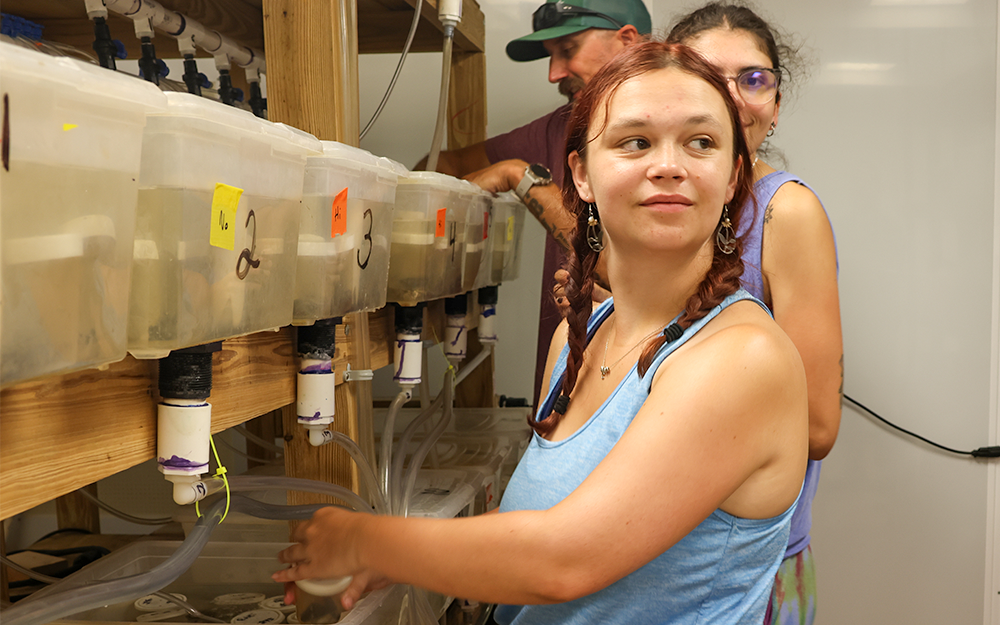
While summer signifies an academic break for most students, undergraduates at William & Mary’s Batten School & VIMS are instead getting back to work as they delve into summer research projects.
Of the 25 students currently enrolled in the bachelor’s degree program at the Batten School of Coastal & Marine Sciences, several have remained on campus over the summer to conduct research across a wide variety of topics. From exploring biological oceanography to studying environmental policy, this rigorous work generates valuable scientific information and provides formational, practical experiences.
 "Research is where you shift from learning about science to contributing to science,” said Christopher Hein, director of undergraduate programs and professor at the Batten School & VIMS. “It's where you start to contribute new knowledge, not just for yourself, but for everyone working in the field. I think that's a really special opportunity.”
Undergraduates at the Batten School & VIMS are known as "Stravitz Scholars” in honor of the historic $50 million gift made in 2025 by Dr. R. Todd Stravitz ’82 and the Brunckhorst Foundations to provide full tuition support to those accepted into the bachelor’s degree program. Opportunities to participate in research projects are additionally supported by Jane Batten’s HON ’17, L.H.D. ’19 transformational $100 million gift which, in part, provides a $5,000 stipend to every undergraduate for independent research, internship or study abroad experience.
According to Hein, such hands-on research not only teaches valuable skills, but also empowers students to further explore their passions.
"They're just so excited to be involved in real, cutting-edge research, and that enthusiasm absolutely reflects back to the faculty,” said Hein. "It helps me remember why I love being a marine scientist.”
A new way of learning
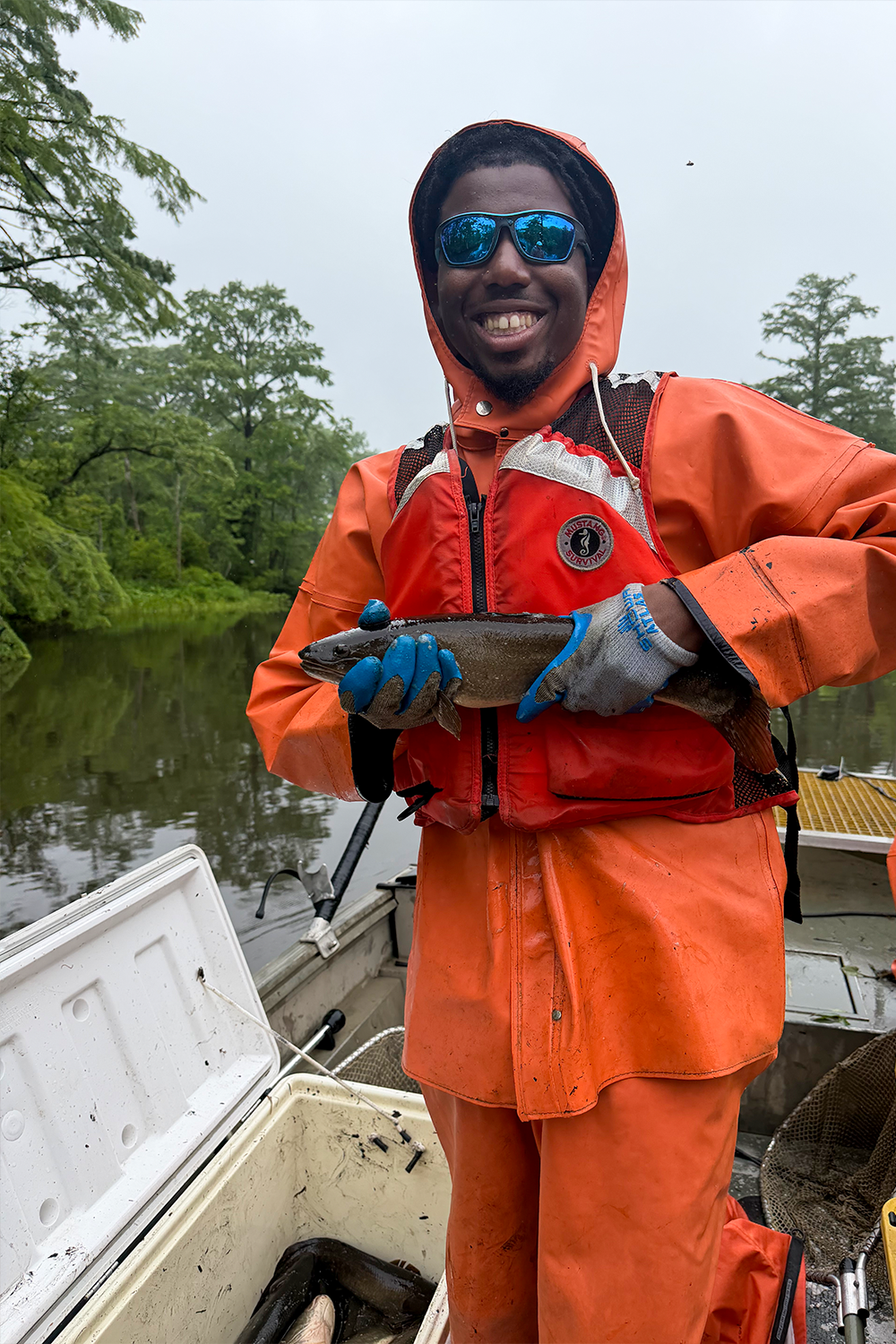
For Darius McCallum, engaging in undergraduate research has been the highlight of his experience in the major. A rising senior who was a part of the inaugural class of students accepted into the bachelor program, McCallum works closely alongside Professor Eric Hilton and Senior Scientist Patrick McGrath to study bowfin (Amia calva). Those experiences have become foundational in McCallum’s development as a young researcher.
"It's nice to see how my skillset has come so far,” he said. "The first year had a lot of challenges, but it was a great experience. I was the most locked in I've ever been and, even though it took a lot out of me, it was interesting to see what I could do. And it's still an ongoing learning process, so I take it day by day and appreciate everything I'm taught.”
 McCallum has spent much of his summer collecting bowfin samples. Field days begin early in the morning as he and McGrath travel to river tributaries along the Chesapeake Bay. The scientists use electrofishing in places like the Piankatank River to temporarily stun bowfin for easy collection. McCallum records the fish’s length and sex before returning most to the water, while a select few specimens are brought back to campus.
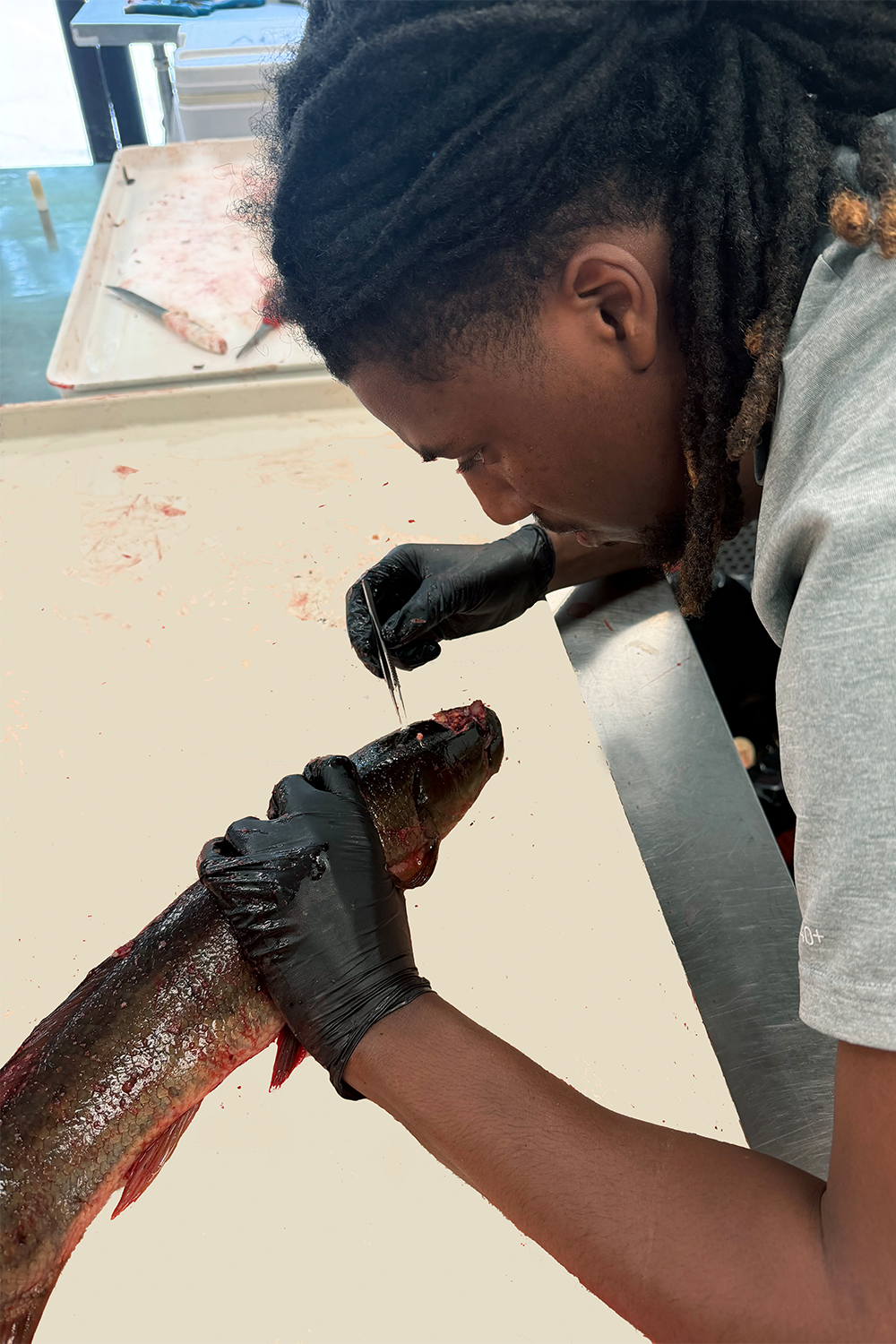
In the lab, McCallum carefully dissects the specimens. He studies their stomach contents — dragonflies, frogs and catfish — and determines their age by inspecting inner ear otoliths. In female specimens, he also counts the number of eggs. From this work, McCallum hopes to craft a research paper which details the extensive life history of bowfin, about which much remains unknown.
"A lot of people see bowfin as just a game fish, but hopefully we can get some more ecological knowledge about it,” McCallum explained.
The importance of being a Stravitz Scholar is not lost on McCallum, who expresses gratitude to the program’s benefactors and faculty for providing opportunities to deepen his passion for research.
"Being a Stravitz Scholar, having access to research and being able to get better materials and tools, makes all the difference,” he remarked. "And shout out to the professors for being willing to take on undergrad students.”
The beginning of a legacy
The Batten School & VIMS recently accepted its second cohort of students to the major, and these new Stravitz Scholars are already getting involved in research. One such student is Caitlin Murphy, a rising junior investigating how parasitic infections transfer from mud snails to fiddler crabs and how these infections may alter fiddler crab behavior.
Working with Professor Jeffrey Shields, Murphy has spent her summer traveling to a variety of collection sites along Virginia’s coast to capture crabs and snails. After sampling is complete, Murphy returns to the lab where she dissects the specimens, looking for the parasite Gynaecotyla. She then compiles field and lab data to analyze how these parasites are impacting fiddler crab populations.
"I think it's so cool to have a portion of my work be in the field collecting these crabs,” Murphy said, "and then another portion be in the lab doing microscopy and dissections. It's the best of both worlds."
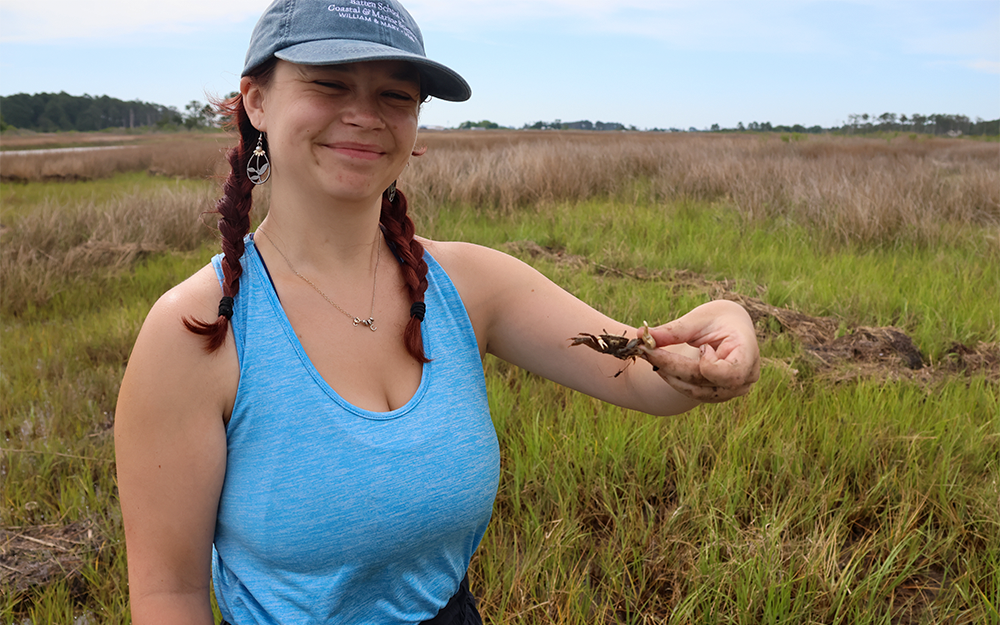 Murphy also hopes to use her data to provide a framework for understanding how warming waters might affect these trends, as fiddler crabs are climate migrants who are moving increasingly further north as ocean temperatures rise.
"It’s a good case study about how parasites affect animal behavior, and also about how crabs are really important to marsh ecosystems,” she said.
Since her admission to the program, Murphy has felt she has been able to enhance the quality of her research due to the abundance of resources made available through the Batten School & VIMS.
"I don't know of another program like this,” Murphy said. "Getting that extra $5,000 through the Batten Fund to continue to do research, especially with the climate nowadays with grant funding — I feel very fortunate knowing that my research is going to be funded no matter what.”
Like McCallum, Murphy aims to publish her findings once her research is concluded. Both students also plan to present their results at the annual Fall Undergraduate Research Symposium hosted by William & Mary's Charles Center. The Center has also provided additional funding to both students; Murphy and McCallum are proud to be a James Monroe Scholar and a WMSURE student, respectively.
That undergraduates at the Batten School & VIMS are participating in much of the same research as graduate students is unsurprising to Hein, who notes his excitement to see the ongoing development of this next generation of marine scientists.
"I saw very early on that these are really bright students,” Hein said. "You name the impact that our research is having in policy, in management, in basic sciences, and I would say that we can find undergrads who are contributing to that work.”