

As striped bass populations decline, Batten School & VIMS electrofishing surveys inform management of an iconic species
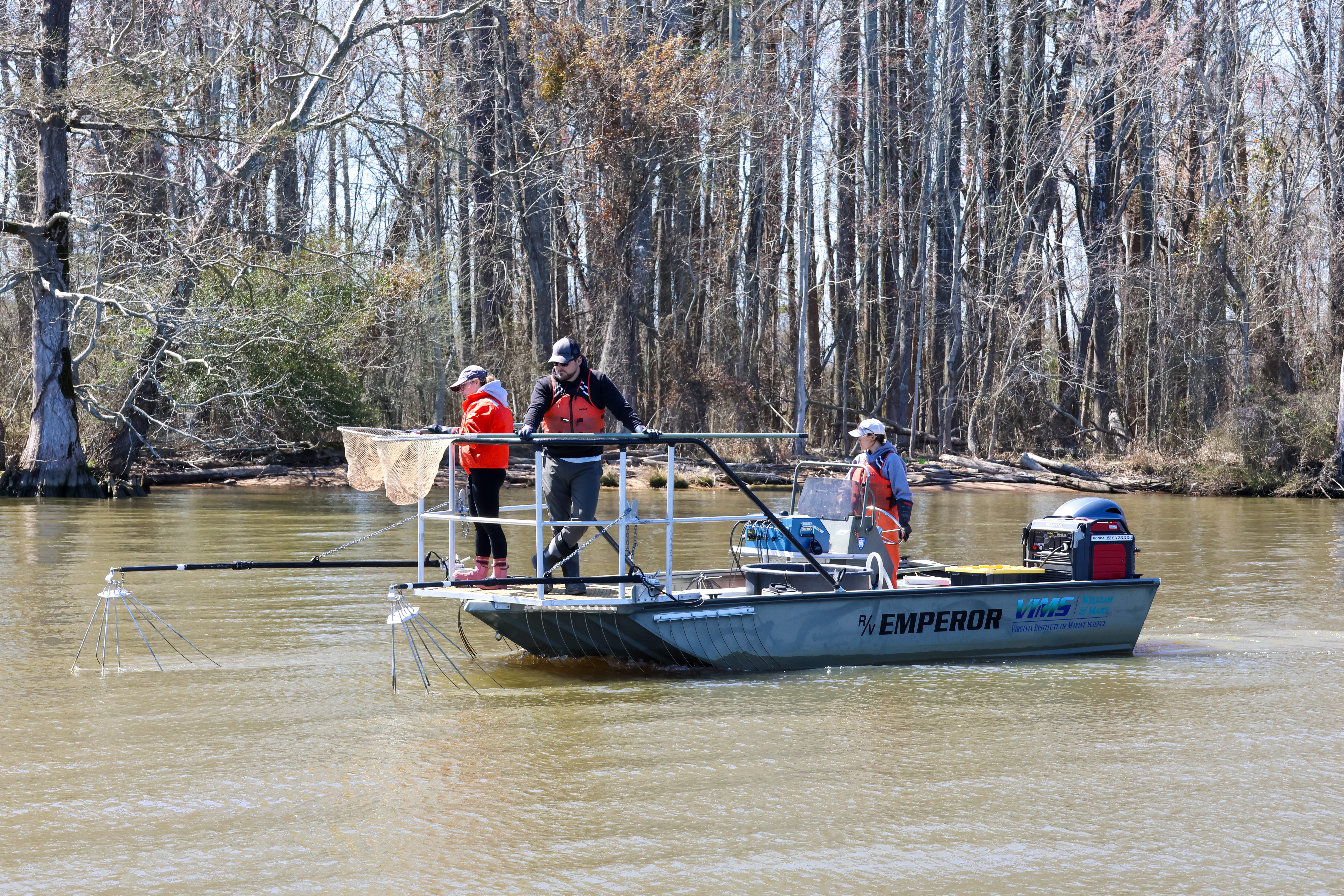 On board their aluminum jon boat, scientists from William & Mary’s Batten School & VIMS survey the Rappahannock River, employing a shocking method to catch and tag striped bass: electrofishing.
Since 1988, the Virginia Institute of Marine Science (VIMS) Striped Bass Program has tagged spawning bass in Virginia’s Chesapeake Bay tributaries, providing critical insights into their survival rates and migration patterns while informing state and federal management decisions for the fishery.
The iconic species is currently classified as overfished, and there has been a steady population decline across the Atlantic Seaboard after years of consecutive low recruitment numbers. As this season's surveys and tagging efforts wrap up, researchers, anglers and fisheries managers will be paying close attention to what the data can tell us about the abundance of spawning bass in the Bay.
Shocking fish provides valuable insights into population concerns
“Something that most people don’t realize is that our aluminum boat is part of the electrofishing system itself,” explained Jameson Gregg, a senior marine scientist at VIMS.
Each spring, VIMS researchers deploy an aluminum jon boat in known striped bass migration routes within Bay tributaries. Equipped with specialized electrofishing equipment, the research team calibrates settings on board based on conductivity to target spawning striped bass within the shallow waters of known spawning grounds.
Gregg explained that a generator passes current through booms extending from the front of the boat, controlled by foot pedals operated by the driver and bowman. “Spheres of electricity are emitted five to 15 feet into the water in any direction,” he said. “As we progress along, fish are stunned and float up to the surface, allowing us to net them and place them into a live well on the boat.”
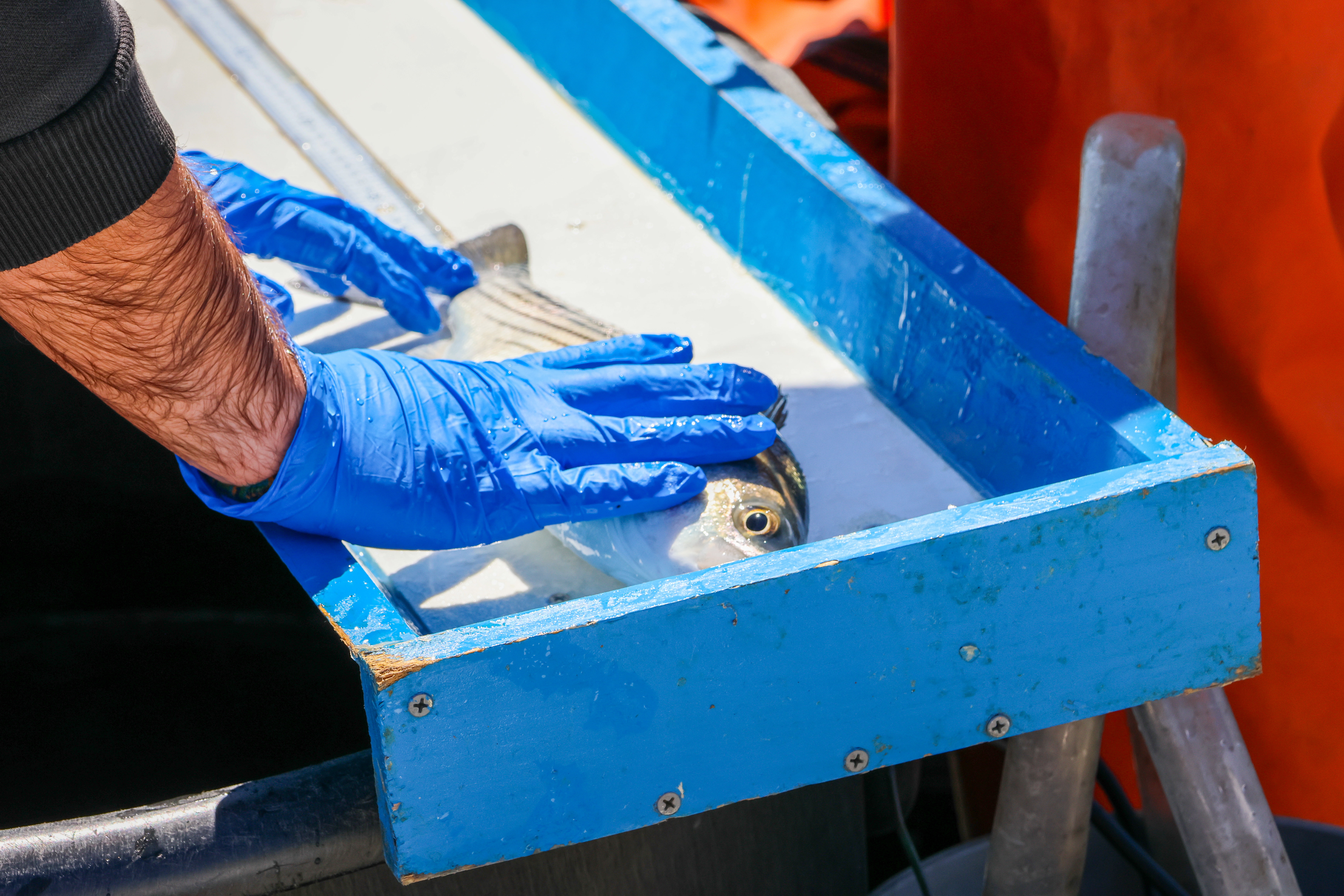 Electrofishing is considered the safest and most effective method for tagging fish. Once on board, the team works quickly to collect data related to each fish, including size, sex and a tissue sample, before then checking for or issuing a tag. The information they gather is added to long-term datasets being referenced at a critical time in the history of striped bass management.
As the boat moves through well-known spawning grounds, the distinction between male and female striped bass becomes obvious with the size of certain fish brought on board.
“The larger striped bass – those above 710 mm, or 28 inches – are what we consider coastal migrants, and the majority of those are female. They’re incredibly important for reaching recruitment and stock goals because of the significant number of eggs they produce,” explained Gregg. “That’s why it’s important for our program to study their spawning patterns and why management measures are designed to protect them. Those regulations help protect larger females to ensure solid annual recruitment and repopulate future year classes of harvestable striped bass.”
As the annual spawning runs continue through Virginia’s rivers, Batten School of Coastal & Marine Sciences & VIMS researchers are leading the charge to understand this iconic fish on behalf of science and society.
Advising management through long-term datasets
A 2019 benchmark assessment by the Atlantic States Marine Fisheries Commission (ASMFC) found striped bass stocks to be overfished and experiencing overfishing along the Atlantic coast. After seven consecutive years of low recruitment in the Chesapeake Bay, the commission now considers the status of the striped bass population to be overfished but not currently experiencing overfishing.
“Overall catches in both the Rappahannock and James [Rivers] have declined since 2020,” explained Gregg, discussing survey trends over time. “This decline has been present in both the monitoring (gill net) and tagging (electrofishing) portions of the survey. When you break down the numbers further, we’re seeing a big decline in male striped bass in our spawning areas. And of those we’re catching, the majority are on the younger side.”
 Striped bass found within Virginia’s portion of the Chesapeake Bay and its tributaries are managed by the Virginia Marine Resources Commission (VMRC). Management decisions have included limitations on when striped bass can be caught within the Bay and its tributaries to allow for spawning to occur, as well as limiting anglers to keeping one fish per day within the permitted size range.
Current proposed regulations in place by the ASMFC and VMRC aim to rebuild the stock by 2029.
Through a combination of electrofishing and gill net methodologies, the VIMS Striped Bass Program assembles critical data for fisheries management in Virginia, the only state where both commercial and recreational fishing of striped bass occurs. The collection of this data is part of a larger information set provided to management officials at state and national levels being used to manage striped bass fisheries.
The VIMS Striped Bass Tagging Program is part of an active cooperative tagging study that currently involves 15 state and federal agencies along the Atlantic coast. The ASMFC and the U.S. Fish and Wildlife Service (USFWS) coordinate the program, while the Striped Bass survey is currently funded by VMRC’s Virginia Saltwater Recreational Fishing Development Fund.
“When this study began, we contracted with fishermen and we’d purchase fish from them to tag and release,” reflected Gregg.
While the team now collects data independently, their work remains closely connected to Virginia’s fishing communities, amassing the data necessary to advise management and policy decisions in support of both Virginia’s fisheries and the long-term survival of the striped bass.