
Scientists forecast milder Chesapeake Bay dead zone in 2026
Below-average nutrient runoff is predicted to result in better conditions for Bay life
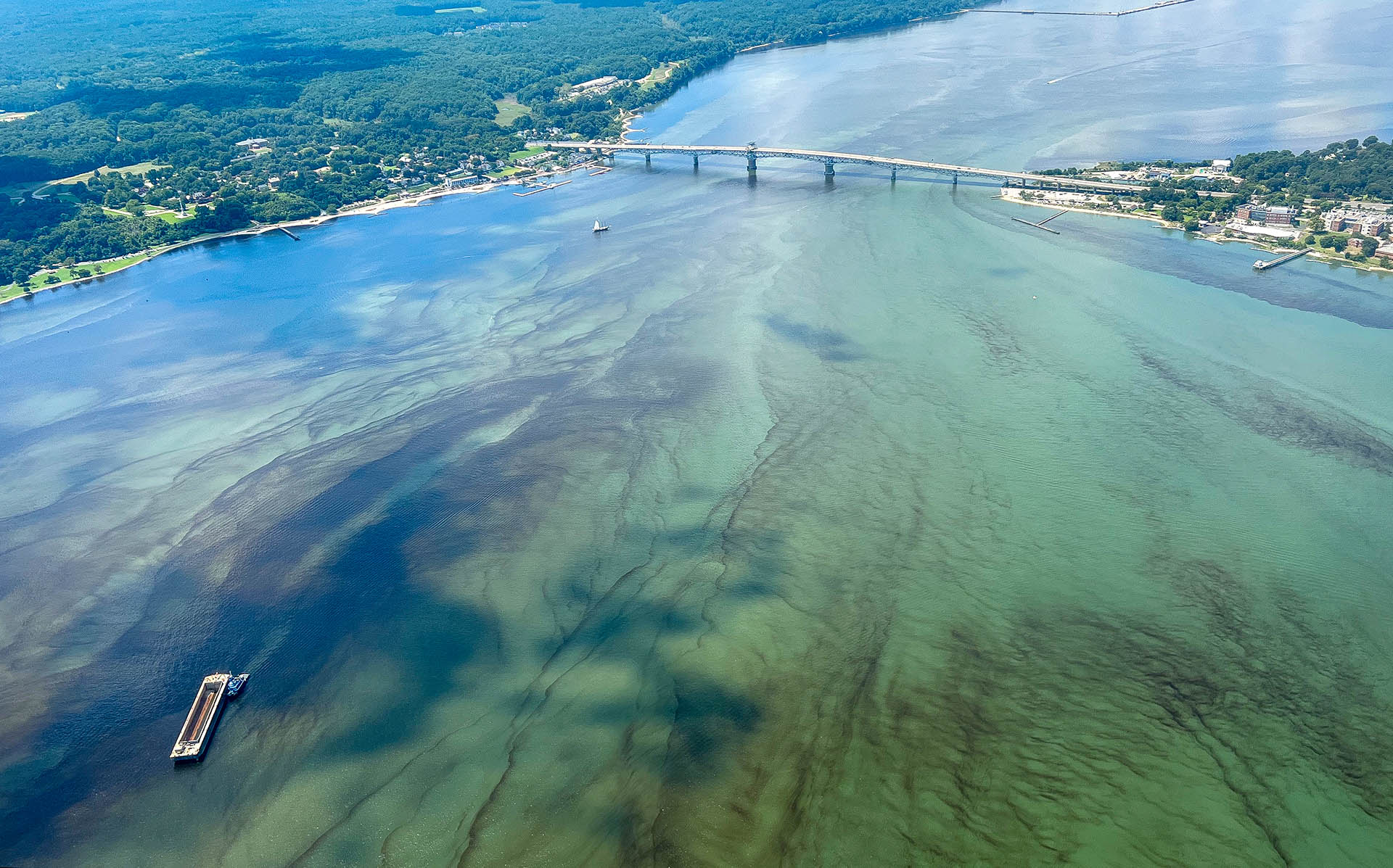 Scientists at William & Mary’s Batten School & VIMS, FlowWest and the University of Maryland Center for Environmental Science announced today that the Chesapeake Bay’s annual “dead zone” is expected to be relatively mild this summer. According to the newly released Chesapeake Bay 2026 Hypoxia Forecast, dead zone severity is predicted to rank among the lowest 10% of years since extensive monitoring began in 1985, and to be about 31% below the long-term average.
This forecast complements the annual Chesapeake Bay Dead Zone Report Card produced by the Batten School & VIMS and FlowWest each fall and marks a return to the annual spring forecast that began in 2007 using a model developed by the University of Michigan. Batten School & VIMS research scientist Dante Horemans worked to update the model and plans to integrate additional improvements moving forward.
“This year’s forecast suggests that the Chesapeake Bay may experience one of its milder dead zones in recent decades,” said Aaron Bever, senior environmental scientist with FlowWest. “Lower nitrogen loads entering the Bay this spring are expected to translate into better oxygen conditions for fish, crabs, oysters and other Bay life this summer.”
Dead zones in the Chesapeake Bay are areas where low-oxygen, or hypoxic, conditions make it difficult for blue crabs, fish and other marine life to survive. Hypoxia occurs when excess nutrients such as nitrogen fuel the growth of large algal blooms, which eventually die and consume oxygen from the water as they decompose.
While the forecast points to a relatively mild year, scientists note that summer weather conditions — such as heavy rainfall, heat waves or extended calm periods — can still influence the size and duration of the dead zone and remain difficult to predict months in advance. The favorable outlook is largely due to low river flows and reduced nitrogen pollution entering the Bay from earlier in the year. From January through April 2026, the amount of water entering the Bay from rivers was 32% below the long-term average, while the amount of nitrogen was 39% lower than average, totaling about 59 million pounds of nitrogen. Using nitrogen load estimates provided by the U.S. Geological Survey, scientists forecast the Bay’s total annual hypoxic volume, a metric that reflects both the extent of low-oxygen waters and the duration of those conditions.
Long-term efforts to reduce nutrient runoff from wastewater treatment plants, agricultural lands, urban and suburban landscapes and other sources have helped improve the Bay’s resilience. These gains are especially important as warming temperatures and changing precipitation patterns can intensify low-oxygen conditions and make continued progress more challenging.
“Annual forecasts, daily environmental predictions and fall assessments each provide a different but complementary view of Chesapeake Bay conditions,” said Marjy Friedrichs, research professor at the Batten School of Coastal & Marine Sciences & VIMS. “Together, they help us understand how the Bay is responding to nutrient reductions, climate variability and year-to-year weather, while also providing useful information for people who use and depend on the Bay.”
This year’s annual dead zone forecast complements the Chesapeake Bay Environmental Forecasting System (CBEFS), which provides five-day forecasts of Bay conditions including sea nettles, harmful algal blooms, salinity, temperature, dissolved oxygen, pH and more. CBEFS is among the few systems in the United States that provides daily forecasts of environmental conditions across an entire estuary and serves as a cornerstone of the Batten School & VIMS’ new Center of Excellence in Environmental Forecasting (CEEF).
CEEF leverages the Batten School & VIMS’ scientific expertise, environmental data and high-performance computing to develop forecasting tools that support the safety, livelihoods and recreation of communities in coastal Virginia and beyond. As part of this effort, Horemans will work to improve the annual dead zone forecast through the integration of machine learning and other artificial intelligence approaches. These advances will help scientists and coastal resource managers better anticipate the severity and location of low-oxygen conditions, while also supporting more accurate and useful forecasts.
“These new approaches can help us better represent how different tributaries and environmental conditions contribute to hypoxia across the Bay,” said Horemans. “That could eventually allow us to forecast not only how severe the dead zone will be overall, but also where oxygen levels may be low enough to affect the behavior of fish, crabs and other marine organisms.”
Throughout the summer, current Bay conditions and forecasts can be tracked through the CBEFS dashboard. In addition to CEEF, CBEFS is supported by the Mid-Atlantic Regional Association Coastal Ocean Observing System, a regional association of the National Oceanic and Atmospheric Administration (NOAA) U.S. Integrated Ocean Observing System, and the NOAA Ocean Acidification Program.