Blog Post body
I always like to talk about why natural history collections are important in general, but especially in Chesapeake Bay. The climate is changing, waters are warming, and we're finding a lot of range extensions and impacts from that change. If we have a great historical record of what we found 30 or 40 years ago and can compare it to what we're getting now, we can see the differences. It allows us to make really great inferences about how animals are moving and what's changing.
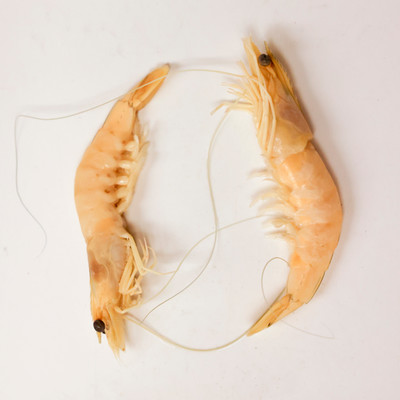
White shrimp are a great example. They'd always been recorded in the Bay in very small numbers, one or two here and there, generally one-offs, maybe ten years ago. But given that the waters are warming and these shrimp were generally found from North Carolina further south, they've actually been showing up in high enough abundances that Virginia Beach was able to develop a fishery. I think there are about ten boats fishing for them now. It's one of those opposite examples in fishery science, where most stocks are depleted. But here, because the water is warming, they were actually able to create a new fishery.
Is it true that these specimens can essentially last forever?
One of the oldest specimens I have is from 1888, collected in Woods Hole, Massachusetts. They're barnacles, stock-bottom barnacles that were probably scraped off a dock. I collected the exact same species three or four years ago.
If you know what these look like alive, you'd see that in the 1888 jar, even though it's 138 years old, the specimens look like they did when they were collected. And my specimens will look the same way in another 138 years.
We take a lot of effort and care to make sure everything is curated properly and stored in 70% ethanol. As long as they're maintained, these can last forever. I always draw parallels to Charles Darwin. A lot of his specimens from the Galápagos were deposited in the London Museum of Natural History, and they look just like when he collected them hundreds of years ago.
What about the digital side of the collection?
The digitization of all this information is really important. In addition to the physical specimens, now you also have long-term digital data to correspond with them, and that data is broadly available to basically anybody in the world. That makes every specimen even more valuable. The specimen itself is properly cared for and can last forever, and now there's a digital record of all the data, where it was collected, all the metadata, that anyone, anywhere can access.
I was the Principal Investigator on a National Science Foundation (NSF) grant to document marine biodiversity through Digitization of Invertebrate collections (DigIn) from 2020 to 2025. The core goal of the DigIn TCN was to broadly transform the availability of accurate marine biodiversity data by providing online access to the nation’s marine invertebrate collections. Most of the undigitized backlog of marine invertebrates were targeted for digitization and mobilization across 19 US collections. The DigIn consortium goals were to:
- digitize 840K and mobilize an additional 180K previously databased lots, representing over 7 million specimens,
- georeference digitized records,
- improve and synchronize nomenclature across collection databases and WoRMS, and
- make >400K images of live specimens and type specimens available online.
DigIn brought the marine invertebrate collections community together for the first time ever, establishing and enhancing standards and best practices in curation and digitization workflows, marine biodiversity research and methods, and engaging the broader marine community to use and extend marine biodiversity data anchored to collections.
We completed the project in October 2025 and I just submitted our final report to NSF. A huge component of the project was getting everything digitally cataloged and into the Specify database.
What does a typical week look like managing the collection?
It varies depending on whether we have outreach events or tours lined up. During the grant, we were prioritizing getting all the specimens cataloged, so there was a lot of database work. Now that we're wrapping up the grant, one of the big things we're focused on is printing new archival labels for every specimen.
We got institutional support to buy a new thermal printer that prints on a plastic paper. The labels can survive in alcohol forever. As we digitized everything, I was able to compare every species name against a taxonomic database to get the most current taxonomy, and that's what gets printed on the new labels.
Because our collection is small enough and I basically started from zero, once we print the new labels we're going to re-shelve everything. Most collections never do that because they're too big. We'll do it this one time at the beginning, and after that, if names change, the database will reflect the current name but we probably won't physically move things on the shelf again.
What's the intake process for adding a new specimen?
So for example, the Blue Crab Dredge Survey is out right now monitoring crabs. If they come across something interesting, they'll text me from the boat: "Hey, do you want this sea star?" And I respond, "Yes, please!" They collect it and bring it back.
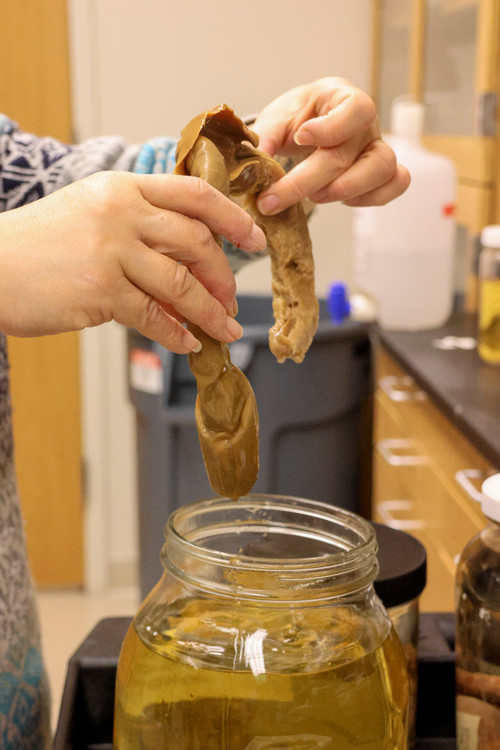
When I'm ready to preserve, I transfer the specimens into 10% formalin. They stay in formalin for a minimum of 48 hours, sometimes longer. Then I take them out, rinse them in fresh water, and transfer them to 70% ethanol, which is the long-term preservative. Everything up in our compactor shelving is stored in that.
At that point the specimen is ready to be cataloged. I get a station code, a date, and all the collection information. If I'm out in the field, I collect GPS data too, take pictures if it's alive; all of that becomes the basis of the catalog record in Specify. We enter the date, location, who cataloged it, when it was identified, whether it's male or female, juvenile or adult, all of it. Then it gets an accession number on top of the vial or jar, and we shelve it by phylum and then alphabetically by family.
How has the collection contributed to research?
Specimens can be used for publications, new species descriptions, new records, new range documentation. There have been a number of papers now, especially in Chesapeake Bay, publishing new records and new ranges. The stone crab is a great recent example: that's a much more southern species, and fishermen have been catching them in Chesapeake Bay.
Now that everything is publicly available, it really puts us in a great position for researchers around the world to use the data. I got my very first loan request last year based on the publicly available data: a post-doc from Brazil wanted DNA from some of our specimens. I ended up going out to collect new specimens in addition to what we already had and sent her some for her work.
There's also a huge education and outreach component. Through the DigIn grant, we participated in educator workshops focused on the value of digital specimen data in K–12 classrooms. We developed an entire lesson plan around an invasive grass shrimp in Chesapeake Bay, showing how you can track when records start showing up, compare them to when the species was first found in the U.S., and follow it across the country into the Bay. Those lesson plans are publicly available now.