

What's a bootery? Another way the Batten School removes barriers to marine science
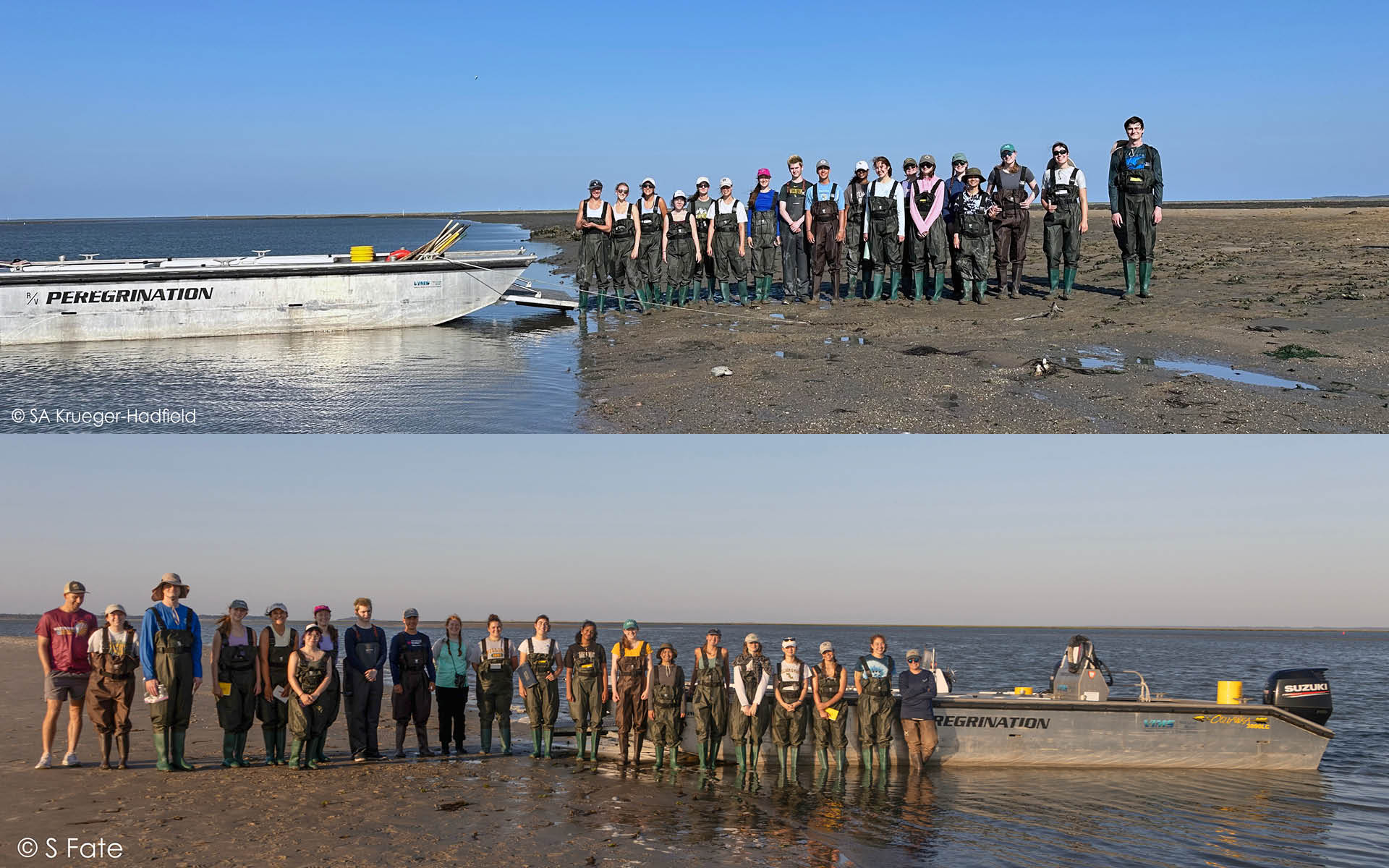 Plankton tows, vibracores, nekton, benthic sampling — odd-sounding terms can be heard all around William & Mary’s VIMS & Batten School. But, have you heard of a bootery?
A wordsmith may know of a bootery as another term for a shoe store, but at the Batten School of Coastal & Marine Sciences it’s a place where students can borrow the gear they need. Specifically, the muck boots, hip waders and chest waders that are all-but-required for pursuing science in marshes, tidal creeks, mudflats and coastal waters.
Thanks to a W&M Provost Mid-Career Leadership Grant, VIMS & the Batten School have established Field Booteries at both the Eastern Shore Laboratory (VIMS ESL) in Wachapreague and the Gloucester Point campus. Together, they provide students with shared access to specialized footwear that can be expensive to purchase for only a handful of uses.
The idea was conceived by evolutionary ecologist and VIMS ESL Director Stacy Krueger-Hadfield and Christopher Hein, coastal geologist and director of undergraduate programs at VIMS & the Batten School, during their participation in William & Mary's Mid-Level Leadership Program.
"Field experiences are some of the most valuable parts of a marine science education, but we recognized that the cost of specialized gear could create an unnecessary barrier for some students," said Krueger-Hadfield. "The Field Booteries are a simple solution that ensures every student has the opportunity to fully participate, regardless of whether they already own the equipment."
The goal is simple: remove barriers to hands-on science.
Getting students into the field
Field experiences have always been at the heart of a Batten School education. Students don't just learn about coastal ecosystems in a classroom; they experience them firsthand.
One day they might be collecting algae from jetties. The next, they're digging through tidal mudflats for invertebrates, collecting sediment cores from barrier islands or boarding research vessels for fisheries surveys.
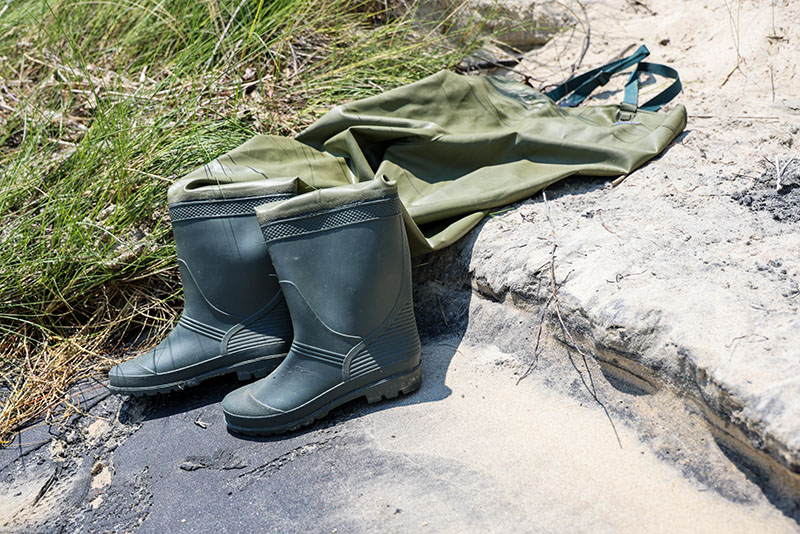 A pair of waders can cost hundreds of dollars, and some students may only need them for one course. The Field Booteries eliminate that financial hurdle while ensuring every student has access to functional, safe equipment.
"Some of the best learning happens when students are immersed in the environments they're studying," said Hein. "We want them focused on the science, not worrying about whether they can afford the right gear."
Today, the two campuses maintain an inventory of 210 pairs of field boots and waders, supporting undergraduate and graduate courses as well as visiting researchers. Equipment is checked out, tracked, cleaned by the borrower, and maintained so it remains ready for the next class heading into the field.
From the classroom to the coastline
The impact of the first bootery quickly became apparent at the VIMS Eastern Shore Laboratory.
Students in MSCI 331: Field Studies in Coastal Marine Environments spent two weeks exploring Virginia's barrier islands, marshes and tidal creeks, using the shared equipment to safely investigate habitats that would otherwise be difficult to access. The Bootery supported every student enrolled in the course, helping them participate fully in activities ranging from oyster reef surveys to marsh ecology and sediment coring.
For many students, the equipment wasn't what stood out — it was the experiences it made possible. These are the memories that define an experiential education, not the frustration of losing a tennis shoe in the mud on Cedar Island because you didn't have the right gear.