

Carpet beetles clean fish skeletons, help scientists explore evolution
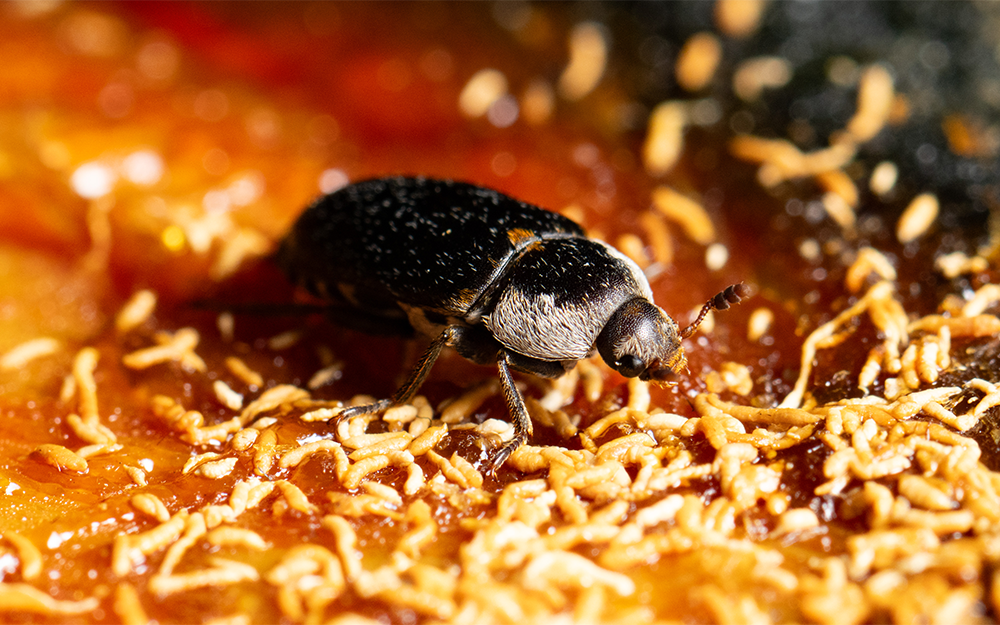 Located deep in the labs of Nunnally Hall at William & Mary’s Batten School & VIMS resides the organization’s hardest working team. Consisting of more than one thousand members, they never stop working and, instead of being fueled by caffeine, they’re fueled by fish carcasses. This team is none other than carpet beetles, whose work has now been put on display through a live stream to educate audiences about the importance of preserving natural history in the face of global change.
While some perceive carpet beetles as household pests, these bugs have a particular talent that’s helpful to marine scientists: they feast on dead fishes. Utilizing carpet beetles to clean skeletal remains is common practice among natural history museums and, compared to other methods of skeletal cleaning, it is both time- and cost-effective. At the Batten School of Coastal & Marine Sciences & VIMS, Ph.D. student Miguel Montalvo uses these beetles to unearth the skeletal secrets of the billfishes he studies, specifically their teeth.
“Storing a billfish as a wet specimen, especially when it’s big, is very difficult,” Montalvo explained. “But making them into skeletons is a way that I can still look at their teeth, store them a bit more easily and preserve them for a long time. So, that’s why I am using the beetles to prepare these specimens.”
{{youtube:medium:right|8uomkyG3Cxk}}
An unlikely ally in the research lab
In the ichthyology lab, fish specimens are placed into the beetle enclosure. Within minutes, the colony begins to swarm the carcasses and devour the fresh meat. Depending on the size of the specimen, it can take the colony of beetles several days to completely clean the skeleton of a fish. Due to the small size of the beetles, no crevice of the skeleton is left untouched by their work. This makes beetle cleaning an often-superior method of skeletal cleaning compared to other approaches, such as chemical treatments, which can damage the remains of the organism and prevent scientists such as Montalvo from gaining the samples needed to complete their research.
The beetles don’t require significant care; they simply need a ventilated enclosure, food and water. Food comes in the form of fish specimens. Montalvo regularly sprays the specimens with water, which both hydrates the beetles and aids in their digestion. The fifth-year graduate student also took it upon himself to build a bigger enclosure for the beetles, one that could hold large samples like adult billfish, which is now visible on the newly published live stream.
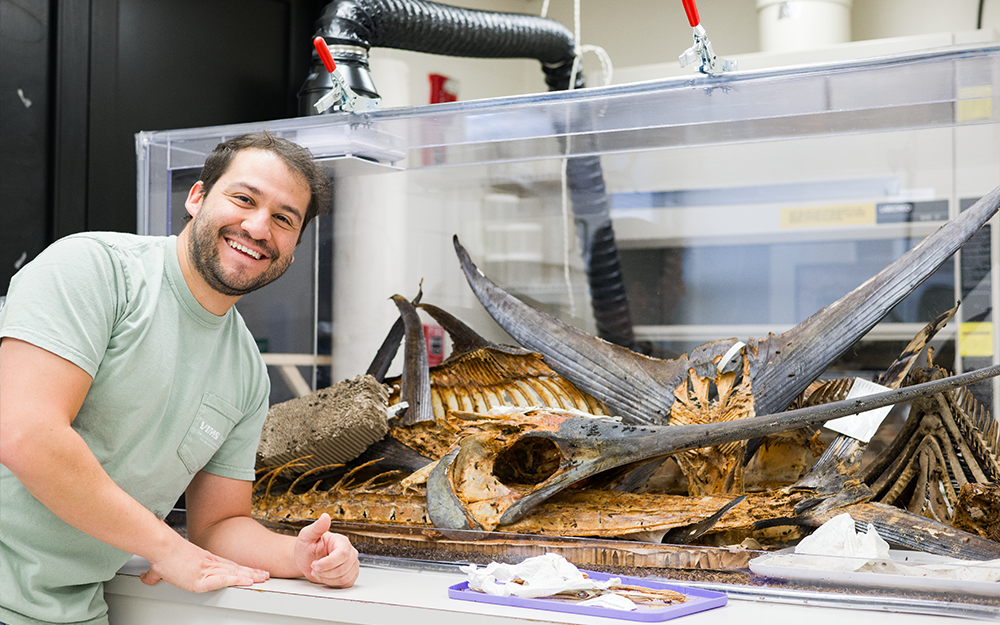 Montalvo hopes the live stream will bring together people and enrich their curiosity in something many consider to be out of the ordinary. Having been inspired by the Natural History Museum in London, Montalvo brought the idea of a live stream to the Batten School & VIMS with the hopes that audiences will understand “the multidimensionality of science and all the things that go into preparing a specimen for a museum or for research,” while developing a newfound admiration for the natural history of the world at large.
Beetle-cleaned skeletons reveal evolutionary insights
Montalvo’s research aims to answer longstanding questions about the evolutionary origins of billfishes and how the unique arrangement of their teeth has changed over time. These beetles allow Montalvo to understand how these changes have persisted while providing valuable information to other researchers from a variety of backgrounds.
Montalvo’s work is done in collaboration with his advisor, Eric Hilton, a professor at the Batten School & VIMS who specializes in the evolutionary morphology of fish and has been using carpet beetles to preserve specimens since 1996.
“These beetles are revealing examples of evolution,” Hilton said.
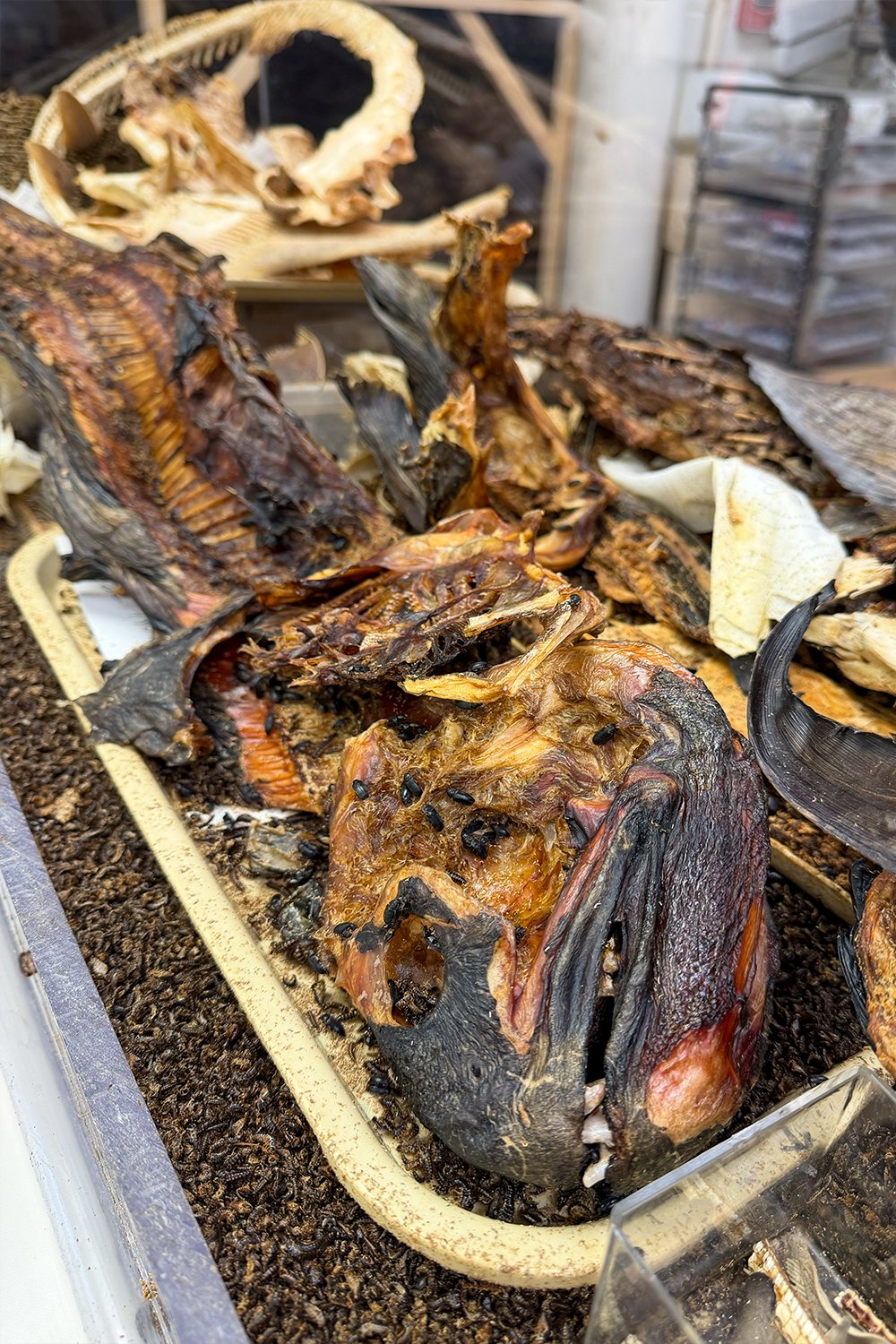 Through these beetles, Hilton and his colleagues discovered how introduced populations of cichlids in southern Florida have morphologically drifted from their native populations found in Central and South America over the span of 20 years. These morphological changes, Hilton hypothesizes, are due to differing environmental factors. If this hypothesis is correct, it could pave the way for scientists to better understand how rapidly species are evolving in response to drastic environmental changes.
Hilton was supportive of Montalvo’s idea of starting a live stream, and he commended Montalvo’s infectious enthusiasm for the research they are conducting. “Anything to encourage people’s interest in what we do is great,” Hilton said. “I think it’s a fabulous thing.”
What Hilton hopes audiences take away from the live stream is simple: society must understand the natural world to save it. The beetles are doing more than consuming flesh for scientists in lab; they are emphasizing the observable evolutionary change that oceanic populations are undergoing as a response to global warming and sea level rise. The unique relationship forged between researchers and the beetles opens a realm of scientific possibilities which Montalvo and Hilton invite audiences to experience through the on-going live stream.
“If we capture the imagination of one person through this,” Hilton said, “we win.”