

OspreyCam
{{youtube:medium|K-cxiJGgPFY, Live feed of the Batten School & VIMS osprey nesting platform on the York River.}}
Watch real-time images of an osprey family during their annual nesting and breeding season on the waters of the Chesapeake Bay. The images come from a nesting platform in the waters of the York River immediately in front of the Batten School & VIMS campus in Gloucester Point, Virginia. The nest site protects the resident ospreys from predators and gives them ready access to nearby fishing grounds. Archived videos of the osprey are available on our YouTube channel.
NOTE: Our feed currently incorporates no audio, due to both technical challenges and to protect the privacy of those on our working pier. If the feed is dark, it is nighttime in the U.S. Eastern time zone (UTC -5) where the VIMS OspreyCam operates.
About ospreys
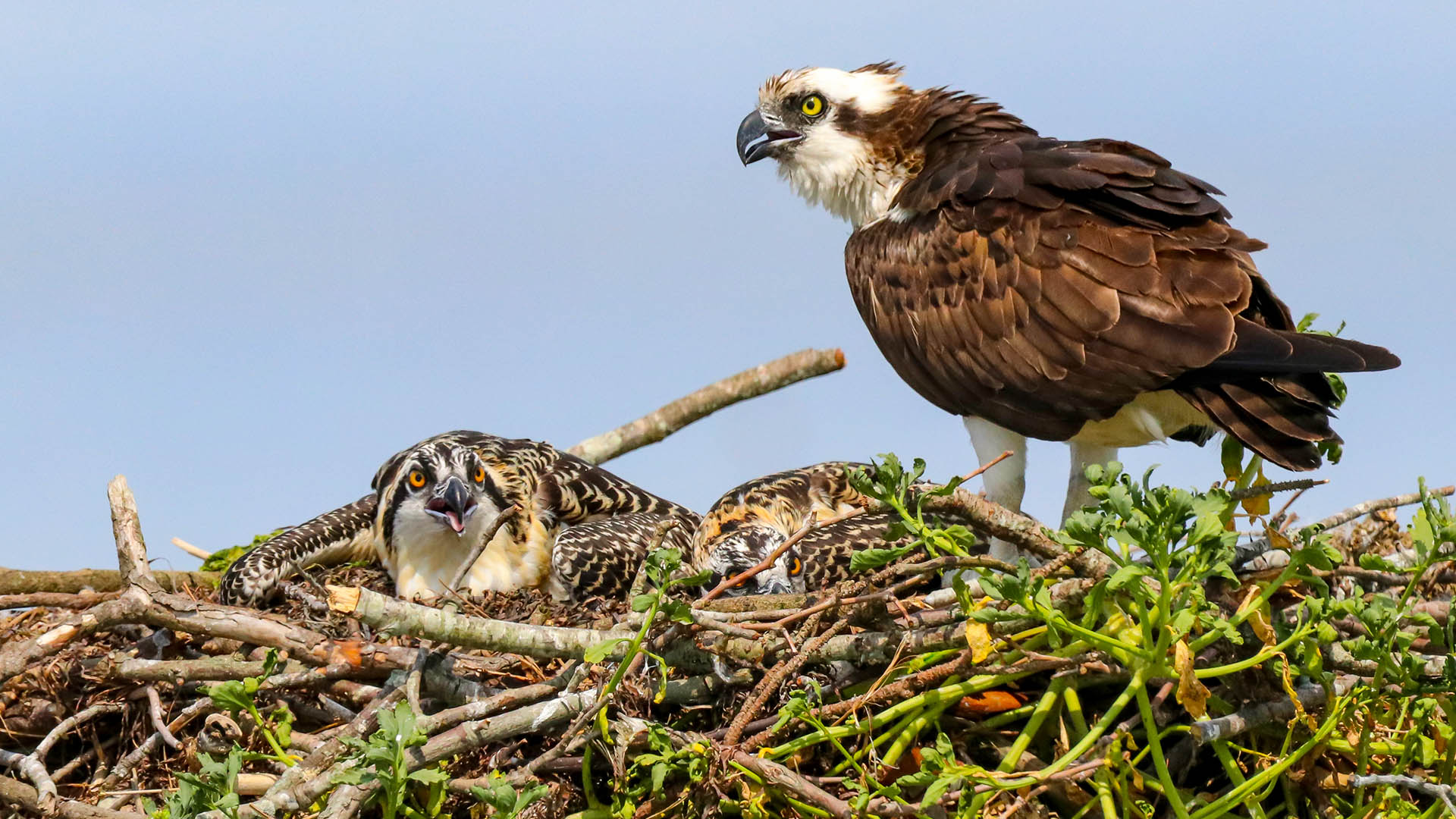 The Chesapeake Bay is home to one of the world’s largest concentrations of breeding ospreys. Also known as “fish hawks,” ospreys return to the same nests year after year. These large birds of prey build stick nests near open water, often on man-made structures like channel markers and nesting platforms.
Once threatened by the pesticide DDT, osprey populations have rebounded dramatically since its ban in 1972. Today, their success across the Bay reflects both improved water quality and the widespread availability of artificial nest sites.
Ospreys spend their summers in the Chesapeake region and migrate to South America for the winter, traveling thousands of miles along established flyways. Their diet consists almost entirely of live fish—especially Atlantic menhaden, perch, and catfish—making them an important indicator of ecosystem health.
Mated pairs typically raise two to three chicks each year. The male performs spectacular sky-dance displays to attract a mate and defends the nest, while both parents share the work of feeding and raising their young.
Fun fact: Ospreys can travel up to 500 miles in a single day during migration, using rising air currents to soar great distances with minimal effort.