
Groundbreaking research comes full circle
Peter Raymond Ph.D. ’99 teaches and studies carbon budgets at Yale, work that first earned recognition while at W&M’s Batten School & VIMS.
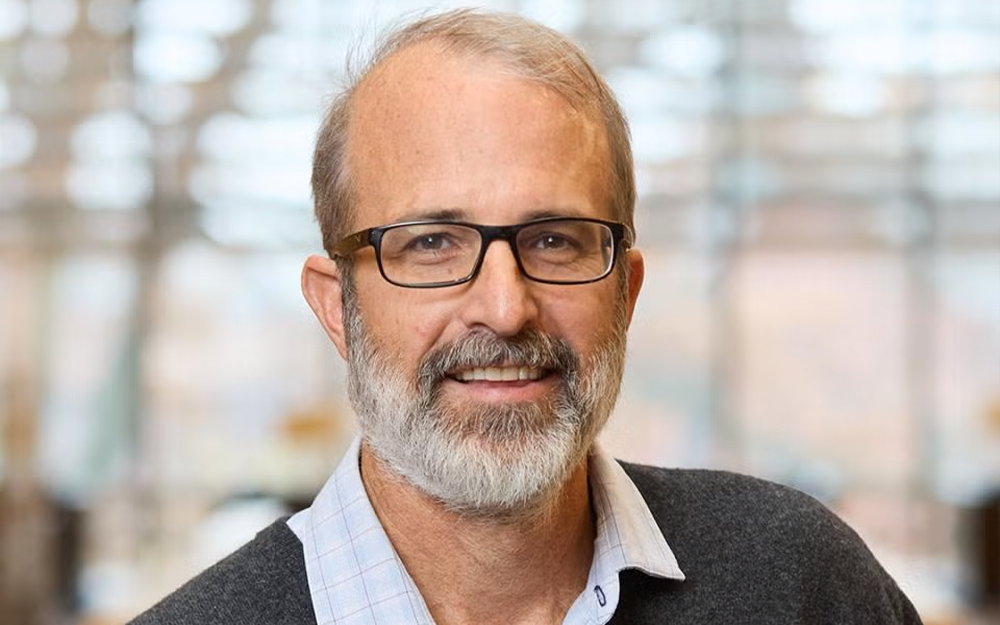 Peter Raymond first arrived at William & Mary’s Batten School & VIMS in an old Volkswagen van, bringing with him only a loyal dog named Bean and an interest in carbon cycling within rivers and estuaries.
That curiosity had first grown while Raymond earned his undergraduate degree from Marist University and then while he worked at the Cary Institute of Ecosystem Studies as a technician. With a strong field background and growing passion for marine science, Raymond began his search for a graduate institution, albeit following a more analog process than today’s Google searches and online applications.
“In those days, you sent people letters in the mail,” Raymond recalled. “I wrote Jim Bauer a letter and he responded.” The exchange ultimately led Raymond and Bean to make their way to the Batten School of Coastal & Marine Sciences & VIMS in 1995.
Raymond quickly found that the Batten School & VIMS offered not only academic rigor, but also a close-knit community. “One of the great things about Gloucester Point is that you’re a little isolated geographically, so you’re all sort of in it together, and the current students were great about welcoming the first-year students,” he said.
With most graduate students living, studying and socializing within walking distance of campus, Raymond found those peer connections strengthening daily, both in and out of the classroom. “I remember we roasted a goat once,” he said. “And some of the folks who worked on the trawl surveys would come back with all sorts of interesting fish to grill.” It was also on campus that Raymond met his wife, Megan Raymond M.S. ’99, an expert in marine geology.
Academically, Raymond’s strongest memories come from hands-on research and life on the water. His doctoral work focused on the York River, where access to the Batten School & VIMS’ boats and facilities allowed him to test ideas in real time. “If I wanted to try something new, it was quite easy for me to do that,” Raymond said. “I had a lot of great memories of being on the river.”
In fact, Raymond’s time at the Batten School & VIMS coincided with major advances in riverine carbon research. Building on undergraduate work he began in New York, which had been one of the first times CO₂ was systematically measured in a river, Raymond worked with Bauer to further advance understandings of carbon budgets.
“Jim taught me how to date the carbon in rivers, and we published a foundational paper on the age of river carbon,” he said. “It was surprising to the field, because we found that a significant percentage of the carbon in river can be quite old, thousands of years old, and that didn't quite fit with the way folks thought about organic matter in rivers at the time.”
With its groundbreaking findings, the very first paper Raymond produced at the Batten School & VIMS was published in the prestigious journal, Nature. “That really launched my career,” Raymond said. “And that work has come full circle; there’s renewed interest in carbon capture, so I’m still studying carbon.”
After completing his Ph.D., Raymond pursued postdoctoral research at the Marine Biological Laboratory and then at Woods Hole Oceanographic Institution before accepting a faculty position at Yale University. “It was my first job,” he said, humbly underselling his hiring at one of the world’s most renowned academic institutions.
Since joining Yale, Raymond has pursued internationally recognized research. He played a key role in integrating inland waters into the global carbon budget through work with the Global Carbon Project. “By creating the first-ever estimate of the surface area of freshwater on the Earth, we published the earliest paper on the total amount of CO₂ coming out of planet’s freshwaters,” Raymond said of the highly cited research. He later developed the “Pulse Shunt Concept,” exploring how hydrologic events move carbon from land into coastal oceans, conceptual work of which Raymond remains understandably proud.
At Yale’s School of the Environment, Raymond has mentored dozens of graduate students and post-doctoral researchers while also serving in significant leadership roles, including several years supervising the unit’s Ph.D. and postdoctoral programs as the senior associate dean of research. Currently, Raymond is co-director of the Yale Center for Natural Carbon Capture, as well as a scientific advisor for CREW Carbon, a technology company that helps wastewater treatment facilities permanently sequester CO₂.
Reflecting on his career evolution, Raymond noted that job satisfaction changes over time. “At some point, you transition to being prouder of the mentoring and some of the administrative and leadership work that you segue into.”
Through both fond memories and ongoing collaborations with fellow W&M graduates, Raymond says he still feels connected to the Batten School & VIMS. “The research and publications that came out of my dissertation were critical to getting me where I am today,” he said, “and I’m continuing to work with people like Joachim Katchinoff ’14,” the co-founder and CEO of CREW Carbon and a fellow W&M alum.
Asked what advice he would give today’s graduating students, Raymond emphasized perspective and balance. “Network hard, but above all remember that it’s a marathon of a race. Be kind to yourself and really work on giving yourself a little space outside of work so that you can stay in the game.”
As he continues to teach, research and serve in leadership roles, Raymond is clearly still at the top of his game, and it was experiences at the Batten School & VIMS that led to his true calling: to be a groundbreaking scientist and a professor educating the next generation of students who arrive at school with a love of science — and maybe a loyal dog, too.