

“The Batten School & VIMS are just part of my life”
Jill Bieri M.S. ’92 leveraged graduate school experiences restoring seagrass into a career leading education and conservation nonprofits.
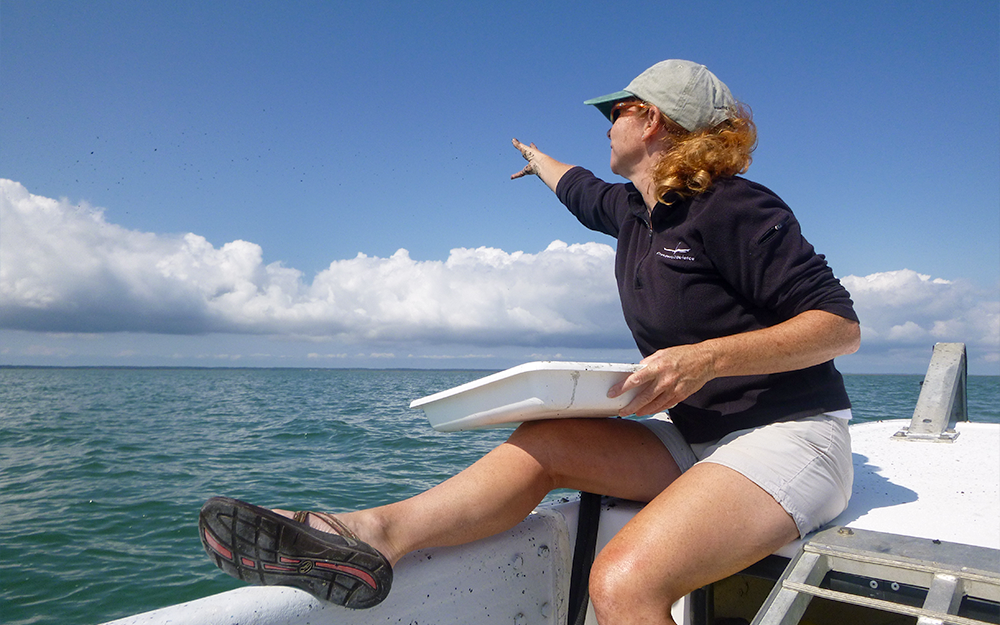 Jill Bieri still remembers the feeling of stepping into seagrass beds in the early 1990s as a graduate student at William & Mary’s Batten School & VIMS. Decades later, that experience continues to shape her work as director of The Nature Conservancy’s Volgenau Virginia Coast Reserve, where she collaborates regularly with the very institute that trained her.
“It was amazing to be in the seagrass, and it drove me to think that this is what I want to do for the rest of my life,” said Bieri. “I’m basically doing the same kinds of things today that I was doing in grad school, and I’m still collaborating with VIMS researchers.”
Having grown up on the Eastern Shore of Maryland, Bieri was always surrounded by water, but she discovered a deeper passion for marine science during an undergraduate summer experience at the University of Maryland’s Horn Point Environmental Lab. There, she connected with scientists studying submerged aquatic vegetation (SAV), and eventually with Batten School of Coastal & Marine Sciences & VIMS Professor Kenneth Moore. Impressed by Bieri, Moore asked her to apply to the school and study in his lab.
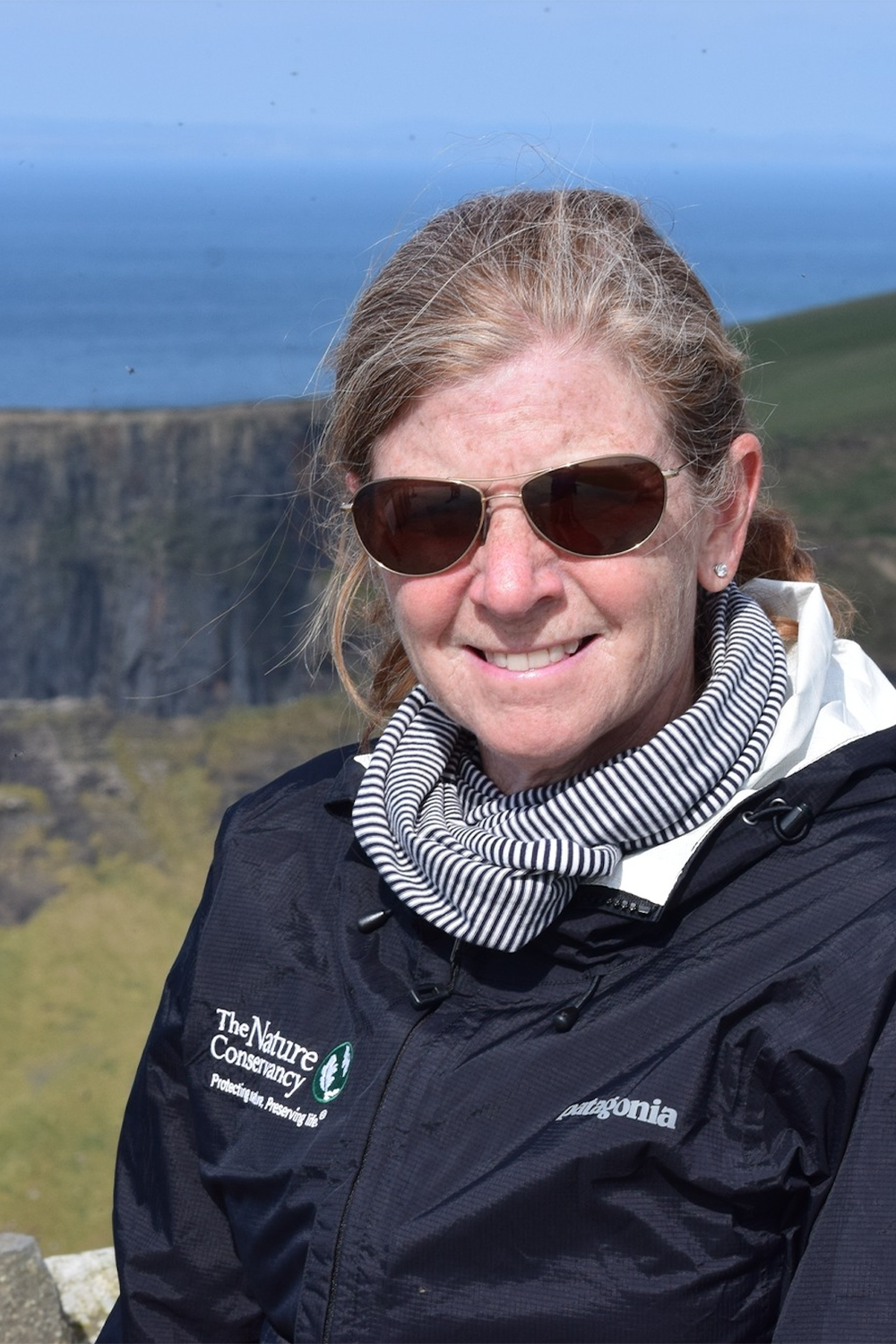 At the Batten School & VIMS, Bieri joined a powerhouse SAV program, including a restoration initiative that would become one of the largest and most successful in the world. “I didn’t know it at the time,” she said, “but our work became globally impactful.”
Her NOAA-funded thesis research in Chincoteague Bay examined how hydrogen sulfide in sediments affected eelgrass photosynthesis. She spent two years conducting complex field experiments, all while curating an influential network of peers and mentors.
“There were always opportunities at the Batten School & VIMS, and it was a very comfortable place where you could ask people for advice,” said Bieri. “I finished my degree in two years and then stayed for three additional years working for Ken as a tech. It was a great place to start and has opened lots of doors for me.”
Those doors led her first to the Center for Marine Conservation (now Ocean Conservancy), then to the Chesapeake Bay Foundation and later to the National Oceanic and Atmospheric Administration. But one of the most defining chapters of Bieri’s career came when she decided to build her own nonprofit: the Chesapeake Experience, an educational venture that turned kayaks into classrooms by offering excursions led by interpretive guides providing instruction about the Bay and marine life.
“I was traveling a lot, but I had two young daughters at the time and wanted to be at home more with them and with my husband. And I loved getting people out into the Bay system and seeing them connect with the coastal environment,” said Bieri. “We decided to start Chesapeake Experience, and it was amazing and had a lot of impact on the community.”
The impact grew quickly. School programs ran throughout the academic year, paired with teacher professional development and youth summer camps. What started as a modest endeavor was soon facilitating 17 camps per season at its height. Yet after seven years, another opportunity emerged. Offered the director role at The Nature Conservancy’s (TNC) Volgenau Virginia Coast Reserve, Bieri saw a chance to bring together her education, science and leadership expertise.
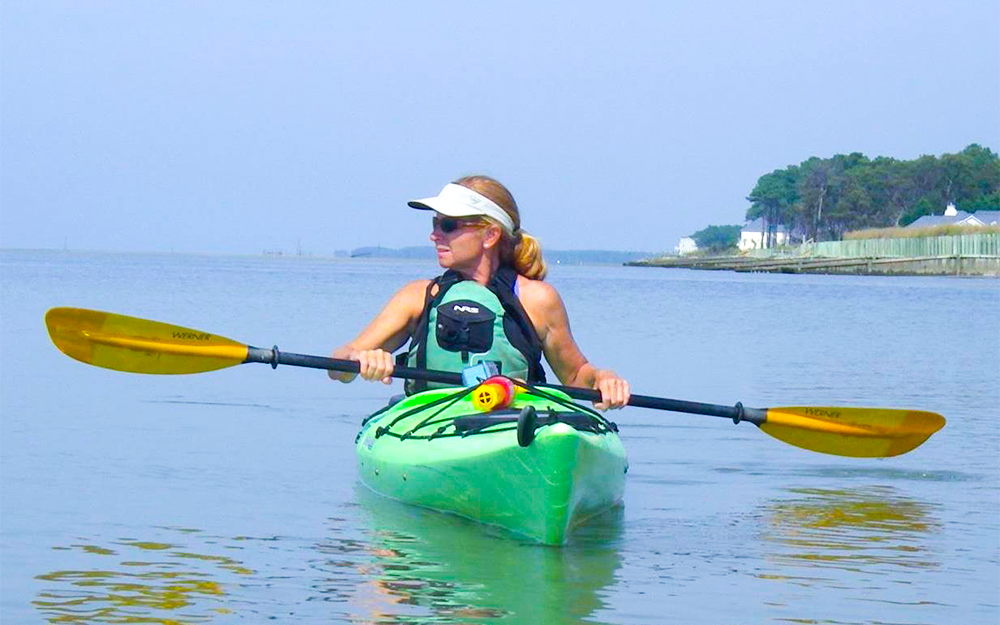 "I thought, ‘what better way to really come full circle, educating students and training teachers while also being in the field and leading research programs,’” she said. Today, Bieri remains in that position, supervising a 14-person team of scientists, educators and land protection staff on the Eastern Shore as they manage approximately 40,000 acres of essential habitat across the mainland and 14 undeveloped barrier and marsh islands.
“Our program has been around for over 50 years. It’s a living laboratory where we can study various things and try different restoration techniques,” Bieri said. “It’s a big job, but it’s an amazing place with amazing people doing really cool work, including our partners at the Batten School & VIMS, both the Eastern Shore Lab and the Gloucester Point campus.”
That partnership between her alma mater and the Volgenau Virginia Coast Reserve includes seagrass expansion, Virginia bay scallop restoration and community engagement efforts. Bieri’s days are otherwise filled with budgeting, fundraising, managing her team and facilities, strategic planning and coordinating with other agencies and organizations. “Some days I'm making these big strategic decisions, and some days I'm picking out a menu for a donor trip,” she said with a laugh.
An ongoing focus at the Volgenau Virginia Coast Reserve is on resilience. “Our local towns and villages on the Eastern Shore are on the front lines of the climate crisis,” said Bieri. “We're seeing high rates of sea level rise over here. Our roads flood, our schools have to be closed, access to emergency services is more difficult. It's not something that 30 years ago I would've thought I'd be working on, but it is really the center of what we do now.”
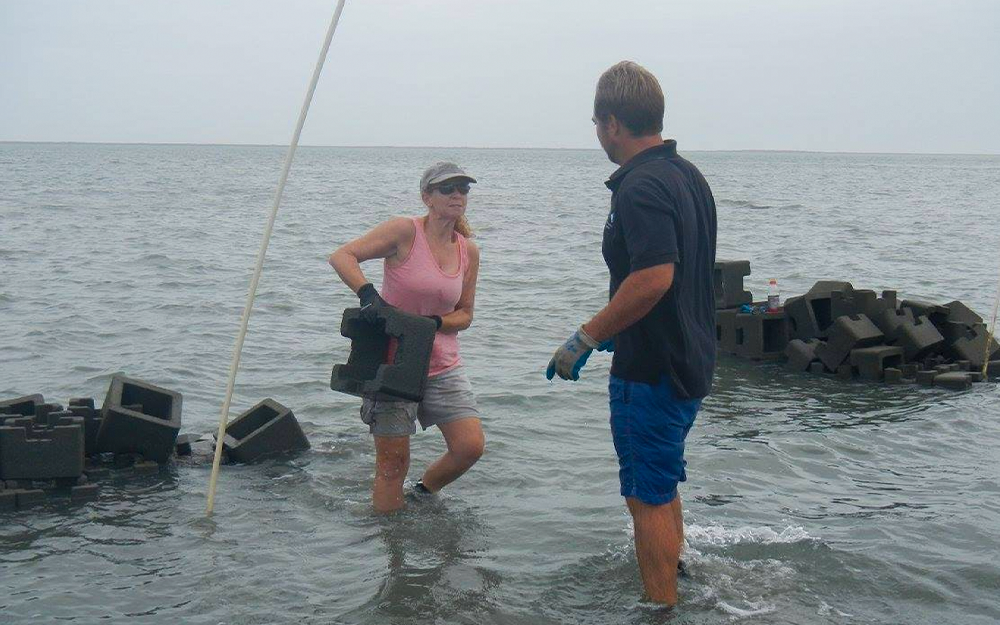 Through it all, Bieri continues to lean on skills developed at the Batten School & VIMS, including critical thinking, developing field experiments and communicating with professional peers. “You have to think on your feet when you're in the field, even more so than when you’re in a sterile lab,” she said. “Grad school taught me how to think and respond, how to build an experiment and organize a field team. And we were given lots of opportunities to participate in professional meetings and interact with people doing similar work, and all of that really helped my development.”
Bieri encourages current students to think broadly about their options. “Try things,” she said. “Use the networks and skills and knowledge that you gain and take some risks. And be creative. There isn't just one box that marine science fits into, and there are so many ways to apply marine science in the world, so be willing to think out of the box.”
Being creative and exploring new pathways is how Bieri’s first steps in the seagrass beds led to her now working with TNC and VIMS on the largest seagrass restoration effort in the world — nearly 12,000 acres and counting. From seagrass research in Chincoteague Bay to founding a nonprofit and leading one of the East Coast’s most significant conservation landscapes, Bieri’s career reflects the rigor and reach of a Batten School & VIMS education, and its enduring influence.
“There’s been so much overlap throughout my career,” said Bieri. “The Batten School & VIMS are just part of my life.”
This alumni profile was published in March, 2026.