

Chattonella subsalsa
Scientific Name
Chattonella subsalsa. Raphidophyte
Distribution
Coastal North America and Europe.
Toxicity
C. subsalsa has been associated with fish kills in the mid-Atlantic region, including in the Virginia waters of Chesapeake Bay. It can produce brevetoxin-like compounds. If the toxin accumulates in shellfish at certain levels, it can cause health risks to people consuming contaminated shellfish.
Ecology
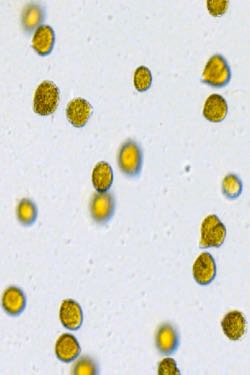 Common bloom species that forms what are often referred to as “brown” tides. It is found across a wide range of salinities (i.e., 15-30 parts per thousand) within Chesapeake Bay and in costal bays of the mid-Atlantic. Blooms are usually reported from April-June when water temperatures are between 60-77° F (15°-25° C).
Role in Batten School & VIMS Research
Batten School & VIMS researchers have responded to several blooms of this organism during the past decade. Some blooms have been associated with fish kills and/or shellfish with detectable levels of brevetoxin. Dose-response laboratory bioassays conducted at the Batten School & VIMS have demonstrated toxicity to brine shrimp.